








Home / Simulation / School Simulator
School Simulator is a free online school game where you run the classroom as the teacher. Before each lesson you arrange the seating plan; then you explain from the board while every student’s attention drains at its own pace, and trouble starts in the back row — chatting that pulls in neighbours, paper planes, jokes, phones, dozing. Call a name to stop it from anywhere, or walk over and quiet everyone near you. In practice, find the students who heard too little and help them. Eight lessons, three stars each, no download or sign-up, and it plays on a phone as well as a computer.
How to play School Simulator
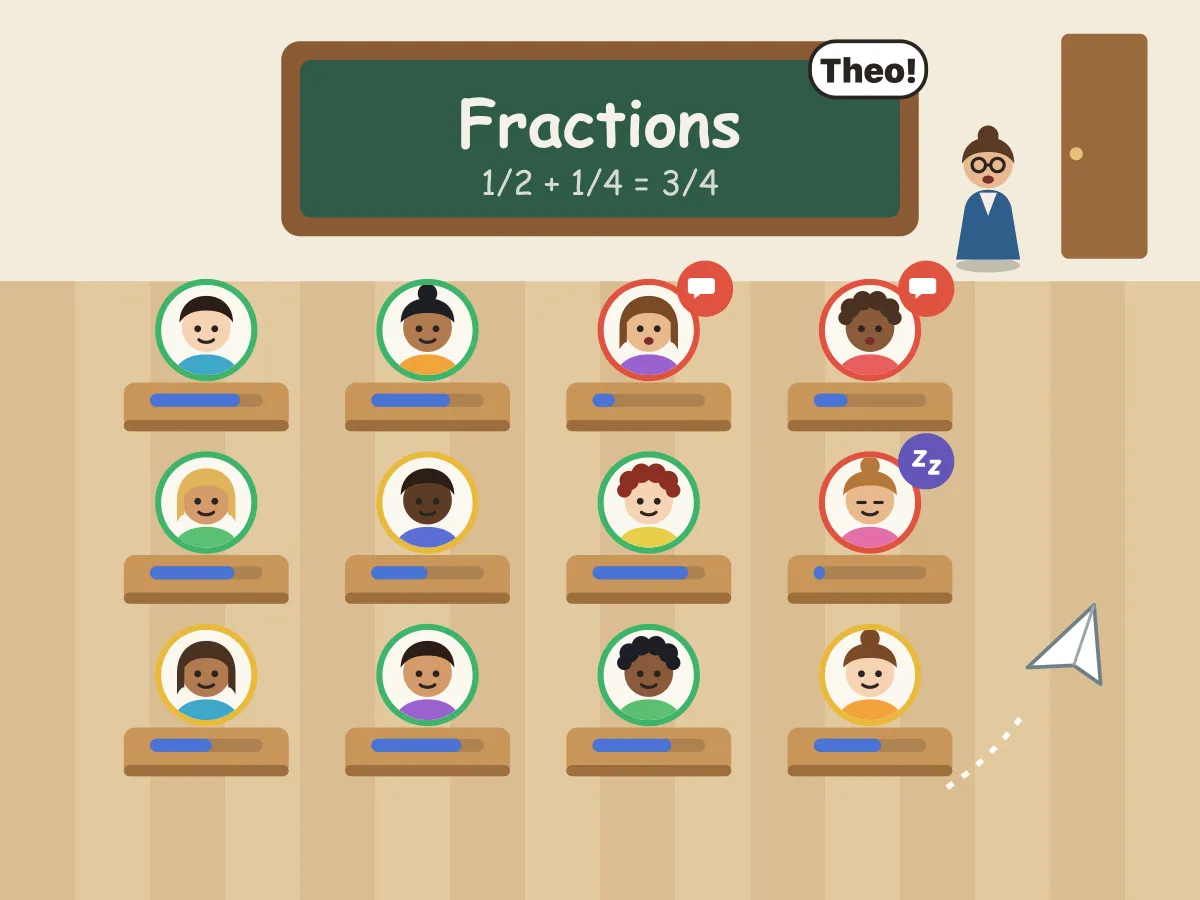
- Plan the seats. Before the lesson, tap one student and then another to swap them. Chatty students set each other off, and trouble starts at the back of the room, so part the chatterboxes and bring the sleepy ones and the class clowns forward. Press Start the lesson when you are happy.
- Explain from the board. While you stand at the board, every student who is paying attention fills the pale part of the bar under their desk. The back rows take in less and drift off faster, and nobody takes anything in while they are misbehaving or while you are walking.
- Stop trouble. A badge shows who is chatting, dozing, on a phone, throwing paper planes or cracking jokes. Tap them to call their name: it stops them at once, from anywhere, but the whole class loses a moment of attention. Walk to a desk instead and anyone beside you settles down on their own.
- Keep them with you. From the board, Ask the class (Q) wakes everyone up a little; asking again straight away is worth less. You also get one stretch break per lesson (B): nobody learns for five seconds, and everyone comes back fresh.
- Help in Practice. In the second half of the lesson students turn what they heard into understanding on their own, shown as the dark part of the bar — except anyone who heard too little, who is stuck. Walk to their desk to help them; their desk neighbours overhear and learn a little too.
- Read the quiz. When the bell rings the class average of what they understood is the grade, and each lesson has three marks for one, two and three stars. One star opens the next lesson; there are eight, from a class of eight to a class of twenty-four.
Tips
- Spend the seating plan on the chatty students first: a chatty student beside another chatty one is far more likely to start talking than one sat among quiet students, and a chat spreads to bored neighbours if you leave it.
- Put the sleepy students and the clowns in the front row. Only the one or two desks right in front of the board are under your eye while you teach — nobody there starts trouble — but the whole front row takes in more than the back, and trouble starts there at a third of the rate it does at the back. With more troublemakers than desks by the board, seat the worst of them there and walk to the rest.
- Call a name for the trouble that spreads — a chat, a paper plane, a joke — and walk over to a lone phone or a dozer when you are heading that way anyway. Every name you call costs the rest of the class a little attention.
- Do not spend the whole of Practice at the board. Walk straight to whoever is stuck: they learn nothing without you, and a few seconds at their desk gets them going on their own.
- Save the break for when the whole class has gone flat, and do not let it go unused — from the fifth lesson on it is worth five points of the class average or more.
FAQ
Is School Simulator free to play?
Yes. It is free in your browser with no download, no account and nothing to buy.
Does it work on phones and tablets?
Yes. Tap a desk to call a name or walk there, and tap the board to go back to teaching. It plays upright or sideways; held sideways the buttons move beside the classroom.
How do I stop students misbehaving?
Tap them to call their name: it stops them at once from anywhere in the room, but everyone else loses a moment of attention. Or walk over — anyone within reach of you settles down by themselves after a moment (someone dozing takes a little longer to notice you), and nobody starts trouble right beside you.
What do the two parts of the bar under each desk mean?
The pale part is what the student has heard you explain; the dark part is what they understand. Explaining from the board fills the pale part, and practice turns it into understanding — never more than they heard. A student who heard less than about a third is stuck and cannot practise until you help them.
Does the seating plan really matter?
Most in the big classes. Test teachers were played through every lesson hundreds of times: in the three biggest classes a good seating plan was worth five points of the class average or more to one who never called a name, and still at least five to a quick one in the biggest class. In the small early classes it matters little.
Can I just teach from the board the whole time?
You can, but the class will not follow you. A test teacher who only lectured never reached a grade of 35 even on the first lesson, and never 25 on any later one — attention drains, the back rows drift, trouble spreads unchecked and the stuck students stay stuck.
How are the star marks decided?
By measurement, not guesswork. Test teachers with different habits play each lesson: three stars sit where a teacher who plans the seats, stops trouble early, asks questions, takes the break and walks the room in Practice clears them and one who only helps and stops the loud trouble rarely does; two stars and the pass mark of 30 sit below those. The marks are re-checked on classes the fitting never saw.
Is it the same class every time?
Teach it again gives you exactly the same class in the same starting seats, so you can try a different plan. New class deals a different set of students and a different seating chart for the same lesson.
Is it based on a real school?
No. The school, the students and their names are made up for the game, and the worst that happens to anyone is having their name called.