





Home / Simulation / Hotel Manager
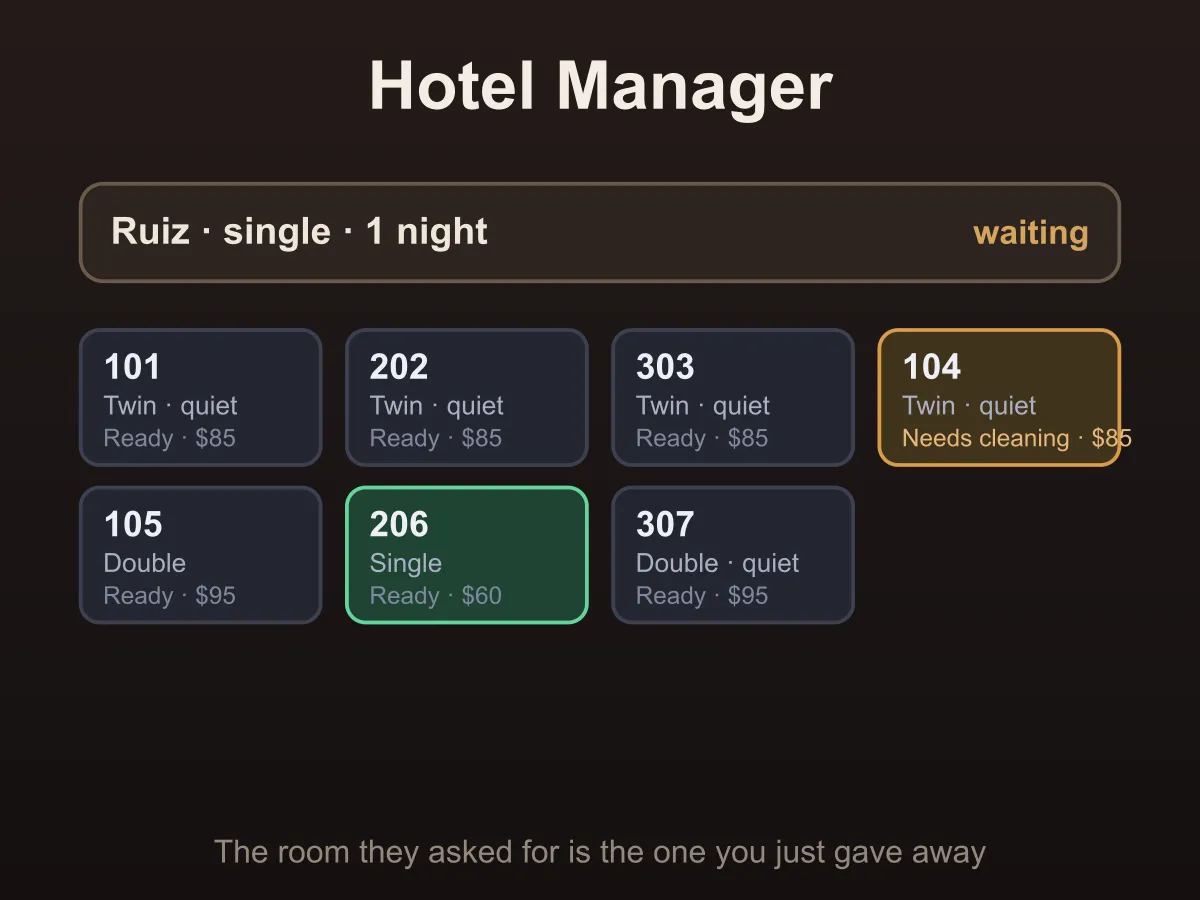
Hotel Manager is a free online hotel management game about allocation. Guests walk into the lobby wanting something specific — a twin, a double, a quiet room away from the lift — and every room in the building is clean, dirty or occupied. Nothing here is typed or counted: the whole job is deciding which room goes to whom, when to send the maid, and who to answer when a room rings down for something. The decision that makes it a game is that a good match now can be a bad night. Give the quiet double to the couple at the desk and the family arriving in four minutes has nowhere to go; hold it back and the couple walk out, which costs four times as much as a wrong room does. Housekeeping is the second call on your attention: one maid, a travel time up the stairs, and the room you most want back is always the one furthest away. The phone is the third — guests in their rooms ring down for towels and taxis, and a call left to ring out costs the hotel a little of its rating. Passing a night needs three things at once — the takings, the hotel’s rating, and the share of guests who actually got the room they asked for — because taking the money is easy and it is the matching that is the job. Six nights, from a quiet Tuesday with four rooms to New Year with twenty guests. No download, no account.
How to play Hotel Manager
- Guests arrive in the lobby wanting a room type — single, double or twin — and some of them ask for a quiet one.
- Tap a guest to select them. The room board then marks every clean room that is what they asked for.
- Tap one of those rooms to check them in. The money goes straight into the night’s takings.
- A room that is not what they asked for still works — they pay 70% and the hotel’s rating takes a small knock. They stay; they just do not come back.
- Every guest has a patience bar. When it runs out they walk out, and a walkout costs four times what a wrong room does.
- Tap a dirty room to send housekeeping. Cleaning takes six minutes plus two for every floor the maid has to climb.
- There is one maid. Sending her somewhere while she is working is ignored, so the order you clean in is a real decision.
- Guests check out on their own as the night goes on, and the room they leave is dirty until someone does it.
- A room that rings is asking for something. Tap it to answer — it takes no time at all, but a call left ringing costs a point of rating.
- Passing the night needs all three: the takings, the rating, and the share of guests who got the room they asked for.
- On a keyboard, the number keys pick the guest in that position in the lobby.
- New Night deals a different set of guests on the same level.
Tips
- Check the arrivals before you fill your best room. The quiet double is worth holding for four minutes if somebody is coming who needs it.
- A walkout costs four times a mismatch, so when a patience bar is nearly out, put them anywhere rather than hold for the right room.
- Send housekeeping to what the lobby wants, not to whatever went dirty first. A clean room nobody needs is a maid you have wasted.
- Distance is time. Two rooms on the maid’s own floor are usually worth more than one perfect room three floors up.
- Nights start with rooms already dirty, so the first thing you do every night is send the maid — before the first guest is even in.
- The takings look after themselves. It is the matching percentage that fails nights, because giving everyone the first free room still earns nearly the same money.
- Long bookings tie a room up for most of the evening. Think twice before putting a three-night guest in the only twin.
- If two guests want the same sort of room, give it to the one whose patience is shorter — the other one can still be matched when a room turns round.
- Answer the phone on your way past. It is free, and on the busiest night a receptionist who ignores it loses more than half the nights a receptionist who does not.
FAQ
Is Hotel Manager free to play?
Yes. It runs in the browser with no download, no sign-up and nothing to buy. All six nights are included and unlock as you clear them.
How is this different from the shop game here?
Supermarket Manager is a counter: arithmetic under interruption with one pair of hands. This is allocation — no counting, no typing, just which room goes to whom and when the maid moves. The two games share a category and nothing else.
Why does the night need a matching percentage as well as money?
Because the till cannot tell the difference. A bot that hands every guest the first clean room takes about 93% of the money a matching bot does — 87% to 96% depending on the night — while putting half as many guests in the room they wanted: 32% against 62%. The matching floor is what makes the difference visible.
Should I ever give someone the wrong room?
Often, yes. A wrong room costs a couple of rating points and 30% of the rate; a walkout costs four times as much and earns nothing at all. The bot that holds out for a perfect room every time loses more nights than the one that compromises, and it loses them to people standing in the lobby.
What happens when a room rings?
A guest in the room wants something. Answering costs you nothing but the moment it takes; ignoring it until they give up costs a point of rating. It is deliberately the cheapest of the three mistakes — the point of the phone is that it competes for your attention while you are deciding something harder, not that it is hard itself.
How does housekeeping work?
One maid, six minutes a room, plus two minutes for every floor she has to climb to get there. She cannot be redirected while she is working, so the order you clean in decides which rooms exist when the next guest walks in.
Do guests ever leave on their own?
Yes — a booking is one to three nights and the room frees up when it ends, dirty. On the busier levels most of the rooms you let out will come back to you at least once before closing.
Are the targets actually reachable?
Yes, and they are measured rather than chosen. A receptionist bot that matches where it can, compromises when a guest is running out of patience, cleans what the lobby wants next and answers the phone plays fifteen of every night in the tests; the targets are set from what it manages. It clears between 9 and 14 nights in 15, while the bot that hands out the first clean room clears 0 to 5 — and the same matching bot with the phone left ringing drops from 9 to 4 on the busiest night.
How many nights are there?
Six, from a four-room Tuesday with six guests to a New Year with eleven rooms and twenty. The guests arrive faster, wait less, and the share of them you have to match rises again at the end. Nobody ever asks for a room the hotel has not got.
Does it work on a phone?
Yes. The lobby becomes a row you swipe along, the room board sits underneath it, and everything is a tap — there is nothing to drag and nothing to type.