
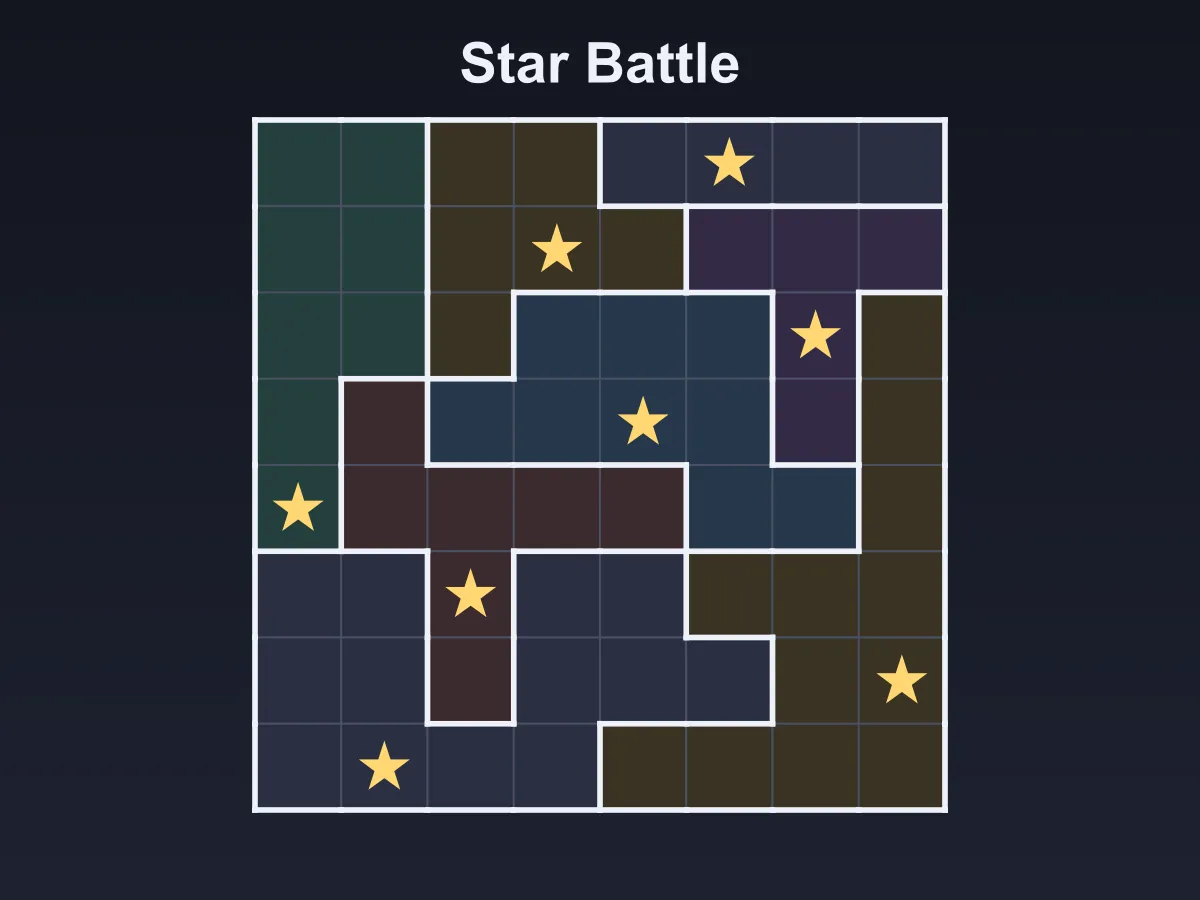




Star Battle is a free online logic puzzle played on a grid cut into outlined regions. Place the same number of stars in every row, every column and every region — one star each on the early boards, two on the later ones — and make sure no two stars ever touch, including diagonally. That last rule is what turns it from a placement exercise into deduction: a star does not just fill its own cell, it rules out all eight cells around it, and a region squeezed into two rows often has only one place left to put one. The regions are drawn with heavy outlines and tinted so that no two touching regions share a colour, because working out where the regions are should never be part of the work. Every board is built from a real star placement and then verified by an exhaustive solver to have exactly one answer, so a placement you can justify is never rejected. Eight levels run from a 5×5 with one star per line to a 10×10 with two. No download, no account.
How to play Star Battle
- Tap a cell once to mark it as having no star, again to place a star, and again to clear it.
- The no-star mark is your own note. It changes nothing about the answer — only the stars count.
- Each row, each column and each outlined region must end up with exactly the same number of stars: one on the early levels, two on the last three.
- No two stars may be in cells that touch. That includes diagonally, so a star rules out all eight cells around it.
- The header shows how many stars you have placed out of the total, and each cell tells a screen reader how full its row, column and region already are.
- Two stars that touch turn red straight away, and so does any row, column or region that has more stars than it is allowed.
- A line that is still short of its stars is never marked red. That is just unfinished.
- Arrow keys move the highlighted cell, and clicking one keeps the keyboard working from there.
- Undo steps back one change. Clear wipes your marks without changing the board. New Puzzle generates a different board on the same level.
- The ? button fixes one cell for you — it removes a wrongly placed star first, and places a missing one otherwise. Three per board.
Tips
- Start with the smallest regions. A region of two or three cells has almost nowhere to put its star, and every cell it rules out helps somewhere else.
- A region that lies entirely inside one row uses up that row’s star — so every other region touching that row has to put its star elsewhere.
- The same works the other way: if a row can only take its star from one region, that region is spent, and everything else in it can be marked off.
- Mark aggressively. Every star you place rules out eight cells, and those marks are what make the next star forced rather than guessed.
- On the two-star levels, look for regions spanning exactly two rows: both of their stars have to go one per row, which usually pins the columns too.
- Two stars in the same region can never be in touching cells either, so a narrow two-star region is often decided immediately.
- When a column has only two cells left unmarked and they are next to each other, neither can hold a star with the other — so on a one-star board, that column’s star is somewhere you have already ruled out, and one of your marks is wrong.
- If a board feels arbitrary, it is not: every one is verified to have a single answer before you see it, so there is always a next cell you can justify.
FAQ
Is Star Battle free to play?
Yes. It runs in the browser with no download, no sign-up and nothing to buy. All eight levels are included and unlock as you clear them.
What are the rules of Star Battle?
Three of them. Every row must hold the same number of stars, so must every column, and so must every outlined region — and no two stars may be in cells that touch, diagonals included. The grid always has exactly as many regions as it has rows, which is what makes "one per region" line up with "one per row".
Do stars really count as touching diagonally?
Yes, and it is the rule that makes the puzzle. A star rules out all eight cells around it, not four. Treating it as four is the usual way a hand-made board ends up with several answers.
What are the dots for?
They are your own note that a cell has no star. They are ignored when the board is checked, so marking one wrongly costs you nothing but time — and on the bigger boards, marking is most of the actual solving.
Does every puzzle have exactly one answer?
Yes, and it is checked rather than assumed. Each board starts from a real star placement, the regions are drawn around it and then reshaped until an exhaustive solver finds a single answer. That is what makes a correct placement impossible to reject and a guess never necessary.
Why has a star turned red?
Either it is touching another star, or its row, column or region already has more stars than it is allowed. Both are wrong the moment they happen. A line that is still short of its stars is never marked, because an unfinished board is not a mistake.
Why are the regions coloured?
So you can see them at a glance. The regions are one of the three rules, and the colours are chosen so that no two touching regions share one — working out where a region ends should never be part of the puzzle.
How many levels are there?
Eight. The first five put one star in each row, column and region on grids from 5×5 up to 9×9. The last three ask for two, on 8×8, 9×9 and 10×10 — a much bigger jump than another row, because two stars in one region constrain each other.
Does it work on a phone?
Yes. Tapping a cell is the whole input, and the board scales to the frame so the full grid stays on screen in portrait.