
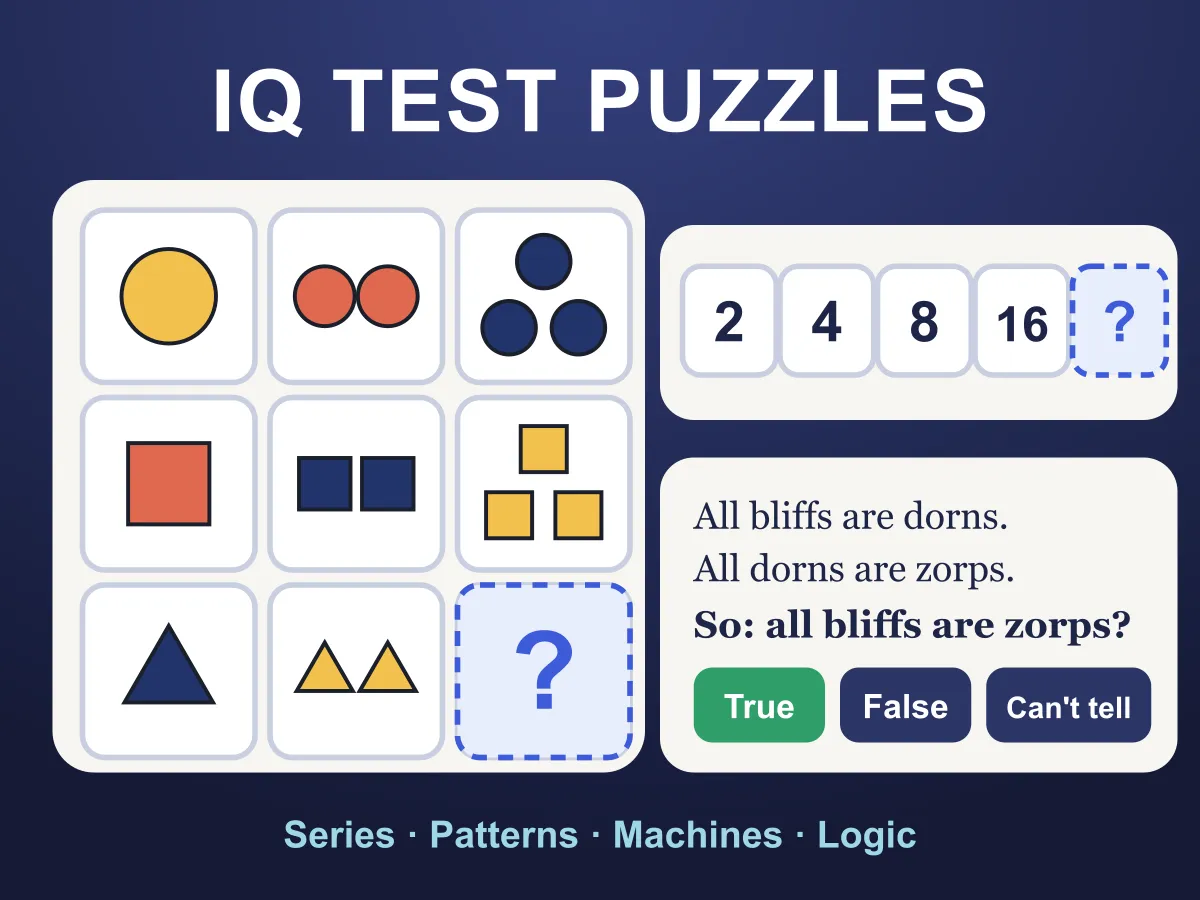




IQ Test Puzzles is a free IQ test game online: sets of ten quick questions in the style of the ones on IQ tests, played in your browser with no download and no account. Each set mixes four kinds of puzzle — number and letter series (what comes next?), 3×3 pattern grids with a missing tile, number machines that turn one number into another, and logic statements to judge True, False or Can't tell. Every question is generated fresh and checked before you see it: the game knows a fixed set of rules for each kind, and a question only appears if none of those rules points to a different answer. After each answer you get the reasoning in one or two sentences. Eight levels run from a warm-up to a set of the hardest kinds, and a Practice mode deals ten of one kind at a time. You score points out of ten and see how you did on each kind — this is a puzzle game, not a real IQ test, so it never gives you an IQ number.
How to play IQ Test Puzzles
- Choose Test (eight levels) or Practice (ten questions of one kind) at the top.
- Each question shows one puzzle: a series to continue, a 3×3 grid with its last tile missing, a number machine with a few examples, or a few statements followed by a claim.
- Pick the answer that fits: tap it, or press 1-4 or A-D. Logic questions have three answers — True, False and Can't tell.
- The right answer lights up green and the reasoning appears underneath. Press Next question (or Enter) to go on; the clock only runs while a question is waiting for an answer.
- A test set has ten questions. Get 5 right to open the next level, the level's mark for two stars, and all ten for three stars.
- At the end you see your points, how many of each kind you got right, and your time.
Tips
- For a series, look at the gaps between terms first. If the gaps change, look at the gaps between the gaps, or check whether two series are taking turns.
- In a pattern grid, take one thing at a time — shape, how many, shading, colour — and ask what it does along the rows and down the columns. Each wrong tile breaks exactly one of those.
- For a number machine, test your rule on every example, not just the first. Adding or multiplying fits two examples easily; the third one is where wrong rules fail.
- In logic questions, ignore what the made-up words sound like and think in groups. "All A are B" does not mean all B are A — if the statements allow both, the answer is Can't tell.
- Every group named in a logic question has at least one member, so "All A are B" also tells you that some B are A.
- Practice mode is the quickest way to get used to one kind before mixing them in a test set.
FAQ
Is IQ Test Puzzles a real IQ test?
No. It is a puzzle game in the style of the questions found on IQ tests, and it gives you points, never an IQ. A real IQ test is given by a qualified professional, such as a psychologist, under standard conditions, and is scored against a large group of people tested the same way. This game has no such group to compare you with, so no score here can be turned into an IQ.
Is IQ Test Puzzles free to play?
Yes. It is free to play online in your browser, with no download, no account and no in-game purchases.
What kinds of questions are there?
Four: number and letter series, where you find what comes next; 3×3 pattern grids, where you find the missing tile; number machines, where a few examples show what the machine does to a number; and logic statements about made-up groups, where you decide whether a claim is True, False or Can't tell. A test set has three series, three grids, two machines and two logic questions.
Can a question have two right answers?
Not by any rule the game knows. Each kind has a fixed set of rules — for series, steady steps, multiplying, alternating steps, growing gaps, two series taking turns, sums of the two terms before and a few more — and a question is only shown if every rule that fits what is on screen gives the same answer. Logic answers are worked out by checking every way the groups can overlap. Someone can always invent a stranger rule, which is true of any puzzle of this kind.
What makes the later levels harder?
Each question has a tier from 1 to 4, set by the simplest rule that explains it: a steady step is tier 1, two series taking turns is tier 3, a Fibonacci-style series is tier 4. Level 1 is all tier 1 and level 8 is mostly tier 4. Measured with a stand-in player that always sees the simplest rules and the hardest ones only now and then, the average falls on every level, from 10 of 10 on level 1 to about 5.3 on level 8.
How are the stars decided?
Five right out of ten passes a level and opens the next one. Three stars need all ten. The two-star mark is set per level from the same stand-in player's typical score: 9 on the first four levels, then 8, 8, 7 and 6.
Is this the same as Brain Trick or Odd One Out?
No. Brain Trick on this site is a set of trick puzzles where the obvious tap is usually wrong, and Odd One Out asks you to find the figure that breaks a hidden rule. IQ Test Puzzles mixes series, grids, machines and logic, with the reasoning shown after every answer.
Does it work on a phone?
Yes. On a phone held upright the game uses a tall frame so the grids and answers stay large, and it works held sideways too. On a computer you can play with the keys 1-4 and Enter.