
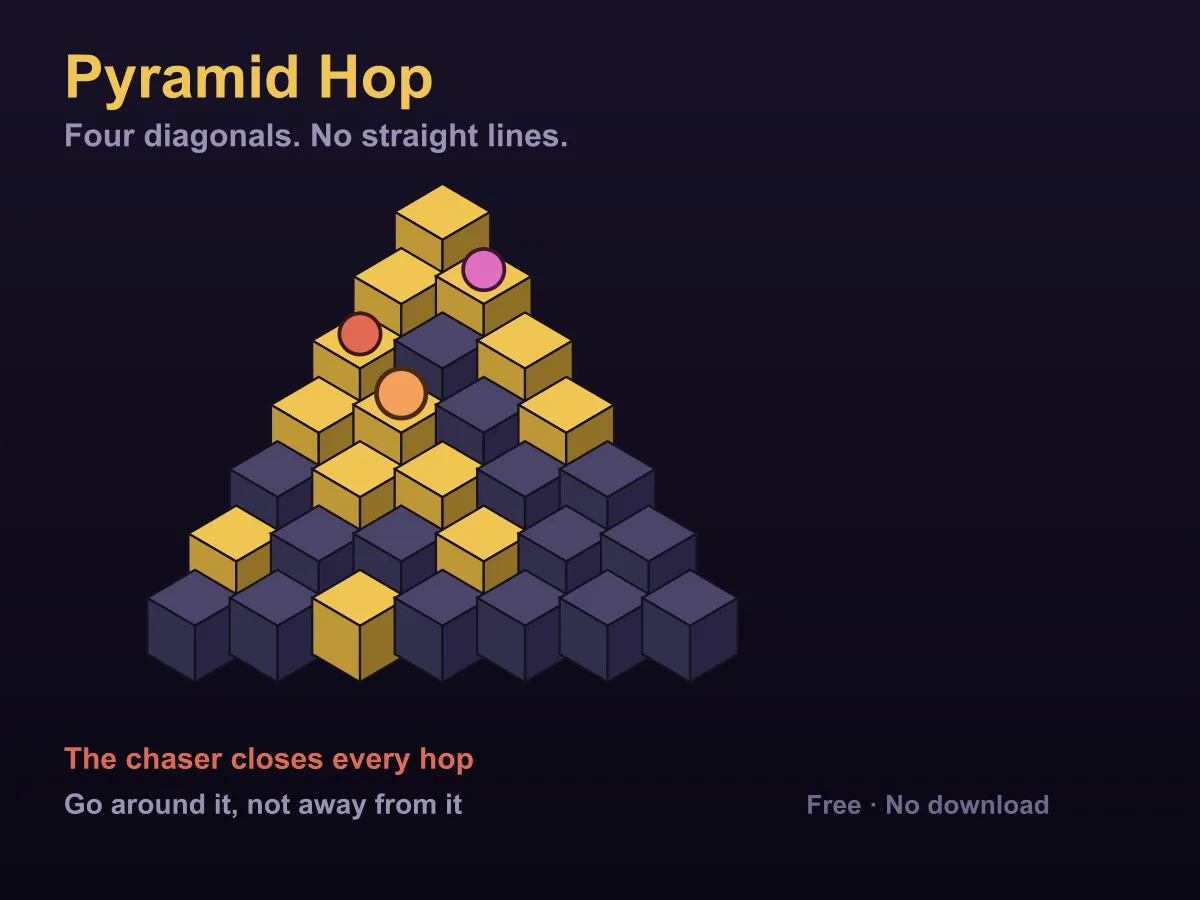





Pyramid Hop is a free online arcade puzzle game for one player: a pyramid of twenty-eight cubes seen from above, and a level that ends when every one of them has changed colour. You only move diagonally — up-left, up-right, down-left, down-right — so the pyramid has no straight lines and no safe direction. That is the whole tension of it: the cubes you still need are at the edges, and a hop that misses the pyramid costs a life. Later pyramids change what a cube asks for rather than just going faster. Some need two hops to finish and some need three, so a route that worked once has to be walked twice; and from the fifth pyramid on, landing on a cube you have already finished undoes it, which turns a careless shortcut into lost work. Two things come down at you. Balls bounce their way down the pyramid at random, and chasers pick whichever of their two downward hops gets closer to you — so a chaser cannot be outrun downwards and has to be gone round. Everything is a fixed-step simulation on the triangle itself, with no pixel coordinates anywhere in the rules, so a seed replays exactly and the whole game can be played without a screen. The pyramid, the creatures and the scoring were written for this game.
How to play Pyramid Hop
- Press Play. You start on the cube at the top of a pyramid of twenty-eight.
- You move only diagonally: up-left, up-right, down-left and down-right. Use the arrow keys or the four-way pad below the board.
- Every cube you land on changes colour. Change all twenty-eight and the pyramid is finished.
- The cube you start on counts, because you are standing on it — so the first pyramid needs twenty-seven more hops at the very least.
- A hop that leaves the pyramid costs a life. There are three, and the edges are exactly where the last few cubes always are.
- From the third pyramid, a cube needs two hops to finish rather than one, and later ones need three.
- From the fifth pyramid, landing on a cube you have already finished undoes it. A shortcut across finished ground now costs you work.
- Pink balls bounce down the pyramid at random. Red chasers take whichever downward hop gets closer to you.
- A chaser cannot be outrun downwards — it is always closing — so the answer is to go around it rather than away from it.
- Anything that lands on you costs a life, and so does hopping onto a cube something is already on.
- Eight pyramids in all, each asking something different rather than just moving faster.
Tips
- Work the edges first. The middle cubes stay reachable from several directions all game; the corner ones only ever have two neighbours.
- Count your way down a side rather than wandering. Every hop lands on a cube, so a route with no backtracking finishes a pyramid in twenty-seven hops exactly.
- Go around a chaser, never away from it. It closes on you with every hop, so the only thing that works is putting a column between you.
- Balls are random, which makes them safer than they look. Watch the one that is two rows above you, not the one alongside.
- On a two-hop pyramid, take a cube to its second stage while you are next to it. Coming back for it later is two hops rather than one.
- On a reversible pyramid, plan the route before you take it. Crossing finished ground is what undoes your work, and it is almost always avoidable.
- The top cube is a trap at two stages. Both hops up from it go off the edge, so you have to come back up to it from below.
- After a fall you restart at the top with the pyramid as you left it. Take the moment to pick the route rather than hopping straight back in.
FAQ
Is Pyramid Hop free to play?
Yes. It runs free in your browser with no download, no install and no account.
How do I move?
Diagonally only — up-left, up-right, down-left and down-right. Arrow keys, WASD or QEZC on a keyboard, or the four-way pad under the board. There is no straight left or right on a pyramid.
How does a pyramid finish?
When every cube has changed colour. On the first two that is one hop per cube; later ones need two or three, so the same twenty-eight cubes take two or three passes.
Does the cube I start on count?
Yes — you are standing on it. It matters more than it sounds: both hops up from the top go off the edge, so a top cube that still needed a hop would be reachable only by coming back up to it from below.
What does a reversible pyramid mean?
From the fifth pyramid, landing on a cube you have already finished takes it back a stage. Crossing ground you have finished is no longer free, which is what makes the route worth planning.
What is the difference between the two creatures?
A pink ball picks its way down at random. A red chaser takes whichever of its two downward hops brings it closer to you, so it cannot be outrun downwards — you have to go around it.
What happens when I lose a life?
You go back to the top and everything that was coming down is cleared, but the pyramid stays exactly as you left it. Three lives and the run is over.
Does Replay this run deal the same game?
Yes. The whole game is a fixed-step simulation on the triangle itself, with no pixel coordinates in the rules, so the same seed sends the same things down in the same order.