










Home / Puzzle / Solo Deduction
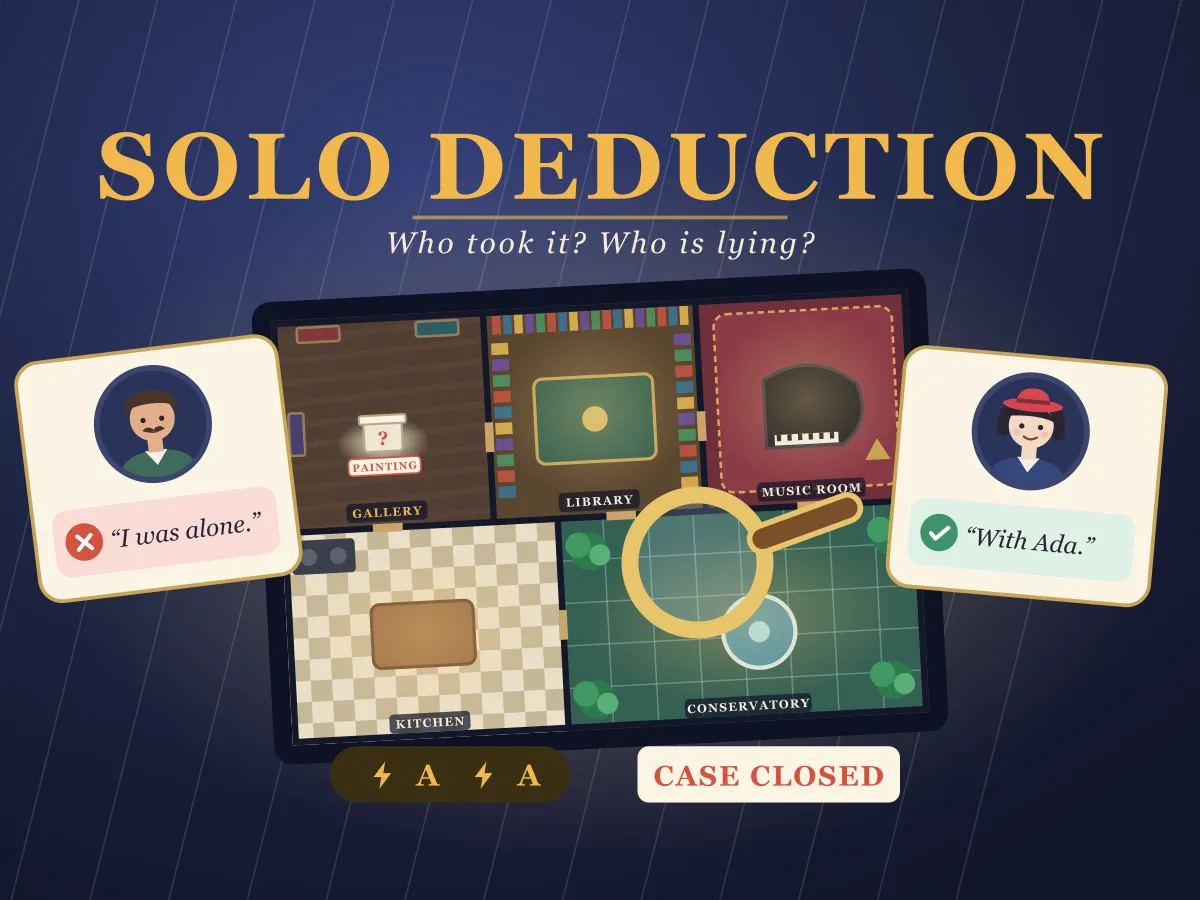
Solo Deduction is a free detective game online for one player: a who-did-it logic puzzle with no opponent and no luck. In every case, a treasure vanishes from one room of Larkspur House during a one-minute blackout. Five guests were somewhere in the house, each in one of five rooms, and exactly one of them was in the room the treasure was taken from — the thief. Each guest gives you three statements. Honest guests tell the plain truth. The liar — two liars from case 6 on — lies at least once, so a liar can still say true things, and that is what makes this deduction game harder than spotting the one bad line. You also search the floor plan: ten to twelve clue cards are hidden in the rooms, and clues never lie. Statements that cannot both be true light up as a lettered pair the moment they are on the table, and a clue that flatly denies a statement lights up once you find it. To close a case you name the whole account, the thief and the liars, with three accusations to spend. Every case was built by a solver and checked to have exactly one account that fits, and none can be closed from the statements alone, so you always need to search the house. Ten cases climb from a warm-up you can read straight off the lit pairs to a two-liar finale that takes four or five facts held in your head at once.
How to play Solo Deduction
- Read the briefing. A treasure was taken from one room of Larkspur House while the lights were out. Five guests were in the house, each in one of five rooms, and exactly one of them was in the robbed room: that guest is the thief.
- Read the statements. Each suspect card holds three lines. Honest suspects tell the plain truth in all three. A liar lies at least once — maybe once, maybe more — so a liar can still say something true. Cases 1 to 5 have one liar; cases 6 to 10 have two.
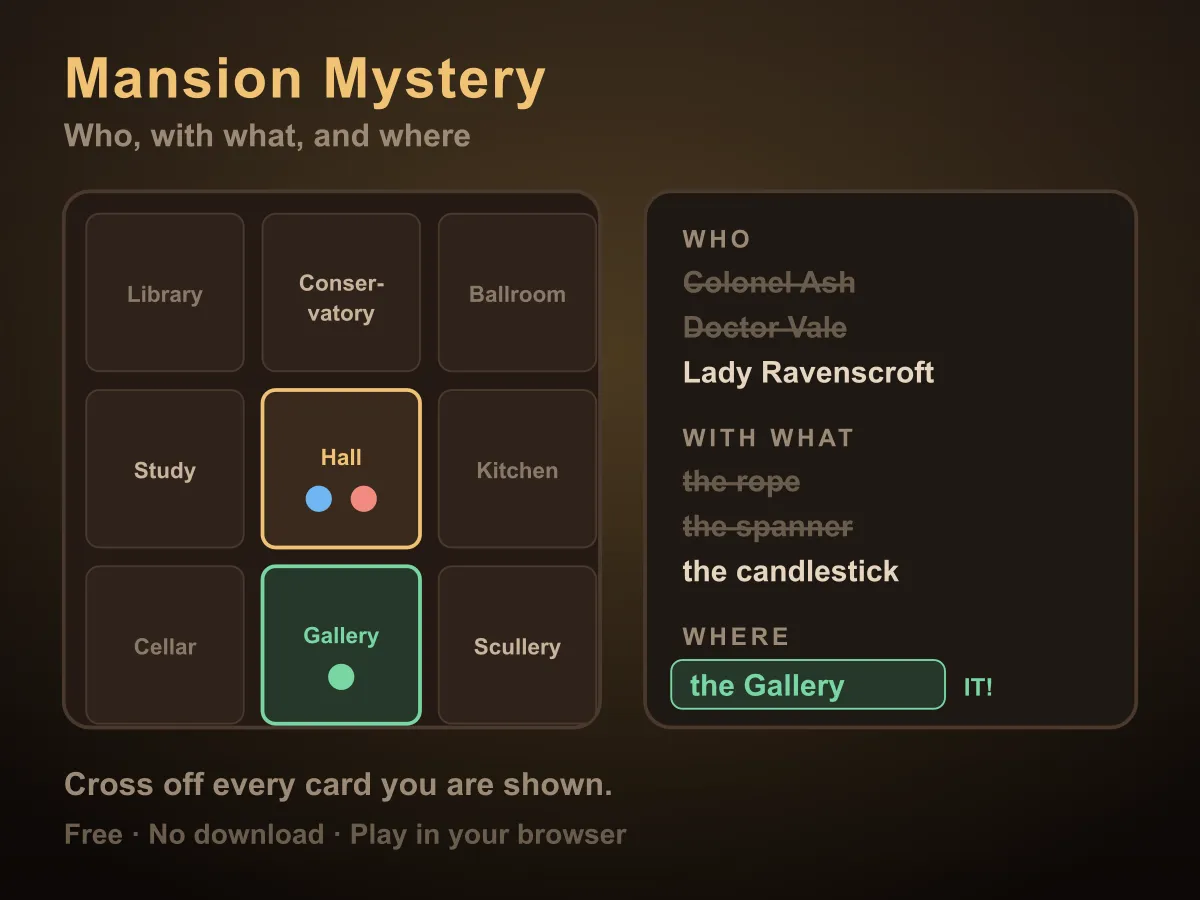
- Search the house. Tap the glowing magnifier spots on the floor plan to find clue cards. Each card says what it shows and, on a plain "Meaning" line, what it proves. Clues never lie. On a phone, switch between the Suspects and House tabs at the bottom.
- Watch for lit pairs. When two statements cannot both be true, both get a lightning badge with the same letter. When a clue you have found flatly denies a statement, that statement gets a blue badge. A lit pair tells you that at least one of the two speakers is a liar — not which one.
- Take notes. Tap a statement once to mark it trusted (green tick), again to mark it doubted (red cross), and a third time to clear it. Marks are only your notes and never count against you, but if you trust both sides of a lit pair the badge turns red to warn you.
- Work it out. Suppose a suspect is the liar and follow it through: everyone else's lines must then be true together with every clue. If that leads to a contradiction, that suspect is not the liar. When only one account is left, the clues and honest statements will place everyone, and the one guest in the robbed room is the thief.
- Accuse. Press Accuse (or A on a keyboard), choose the thief, and choose the liar — or the two liars. You have three accusations per case. A wrong one costs a magnifier and is crossed off so you cannot make it twice; after the third wrong one the trail goes cold and you can reopen the case or see the answer.
- Close the case. A right accusation stamps the file closed and shows the case notes: every lie that was told and what really happened. Three stars for no wrong accusation, two for one, one for two. Closing a case opens the next one.
- Stuck? Press Hint (or H). It picks a wrong idea about who lied and shows the smallest set of statements and clues that cannot all be true if that idea were right, outlining them in the case. Hints cap that case at two stars. Your stars, open cases and half-finished notes are saved in this browser.
Tips
- Start with the lit pairs. Every pair says one of two speakers is lying. In a one-liar case, a suspect who appears in two different pairs is very likely your liar, because one liar can explain both — two different honest people cannot.
- Test one suspect at a time. Say "if Clara is the only liar", then treat every line by everyone else as true and check it against the clues. A clash anywhere sinks that idea. This is exactly how the game checks its own cases, and it always works.
- Remember that a liar lies at least once, not always. Do not throw out all three of a suspect's lines because one of them is false. Their true lines are often the ones that place the thief.
- Search every room before you accuse. The statements alone never settle a case here; at least one clue in every case is indispensable, and room counts ("two warm teacups") are the strongest clues of all because they pin how many people were in a room.
- Use the robbed room. Exactly one guest was in it. Once the liars are settled, anyone an honest statement or a clue puts elsewhere is cleared, and anyone the robbed room's own clues count is fair game.
- Watch out for statements about other people. "Bruno was in the gallery" from an honest speaker is as good as a clue about Bruno. From a liar it may be one of the lies — so settle the liar first.
- In two-liar cases, look for the pair of liars that explains every lit pair at once. If one of your two suspects is in none of the pairs, ask what forces them to be lying — usually a clue that only their lie can contradict.
FAQ
Is Solo Deduction free to play online?
Yes. Solo Deduction is a free detective game you play in your browser, with nothing to download and no account or sign-up. All ten cases are free to play in order: closing a case opens the next one. There is no timer and nothing to buy.
How do you play this detective game?
Read the three statements of each of the five suspects, tap the glowing spots on the floor plan to find clue cards, and use the lit pairs — statements that cannot both be true — to work out who is lying. When the facts leave only one account, press Accuse and name the thief and the liar or liars. You have three accusations per case.
What counts as a liar in Solo Deduction?
A liar is a suspect who lies at least once in their three statements. They may lie in one line and tell the truth in the other two, or lie more than once. Every other suspect tells the truth in all three lines, and clue cards never lie. Cases 1 to 5 have one liar and cases 6 to 10 have two.
Does every case have exactly one answer?
Yes. Every case was built by a solver and is tested to have exactly one possible account: one thief and one set of liars that fits every clue and every honest statement. The solver also checks that each lie is settled, so the case notes you see after closing it are the only way it could have happened.
Can I solve a case without finding the clues?
No. In every case the statements alone leave at least two accounts open, and at least one clue is indispensable: the case cannot be settled without it. That is deliberate. Searching all five rooms is part of the detective work, and some of the strongest evidence — how many people were in a room — only comes from clue cards.
What do the lightning letters next to statements mean?
Two statements with the same lightning letter cannot both be true, so at least one of the two speakers is a liar. A blue badge means a clue you have found flatly contradicts that statement, so its speaker must be lying. If you mark both sides of a lit pair as trusted, the badge turns red to warn you that your notes contradict each other.
What happens if I accuse the wrong person?
You lose one of your three accusations and that exact accusation is crossed off, so you cannot make the same mistake twice. The game does not tell you which part was wrong. After a third wrong accusation the trail goes cold: you can reopen the case from the start with your notes cleared, or choose to see the answer and the case notes.
Can I just guess the thief?
Not usefully. You must name the thief and the liars together, which makes 25 possible accounts in a one-liar case and 50 in a two-liar case. Three blind guesses close a one-liar case 12% of the time and a two-liar case 6% of the time, and a guess never earns three stars unless the first one is right.
How do stars and hints work?
Closing a case with no wrong accusation earns three stars, with one wrong accusation two stars, and with two wrong accusations one star. A hint shows the smallest set of statements and clues that rules out one wrong idea about who lied, and outlines them in the case. Any hint caps that case at two stars. Replaying a case can raise its stars.
Is Solo Deduction a murder mystery?
No. Every case is a theft at a country house — a painting, a silver ladle, a first edition, an orchid and so on — so it is suitable for players of any age. Nobody is hurt, and the suspects are friendly paper-doll characters. The challenge is pure logic: who was where when the lights went out, and who is not telling the truth.
Can I play Solo Deduction on my phone?
Yes. It is built for touch: on a phone held upright, the suspects and the house each get the whole screen and you switch with the tabs at the bottom. Turned sideways or on a tablet or computer, both sit side by side. On a keyboard, arrow keys move between statements, Enter marks them, A accuses, H gives a hint and Escape closes a card.
Is my progress saved?
Yes, in this browser. Solo Deduction remembers your stars, which cases are open, and the notes of any case you leave half-finished — your trusted and doubted marks, the clues you have found, the accusations you have left and the ones you have crossed off. Clearing your browser data, or a private window, starts over.
How is this different from a logic grid or a find-the-impostor puzzle?
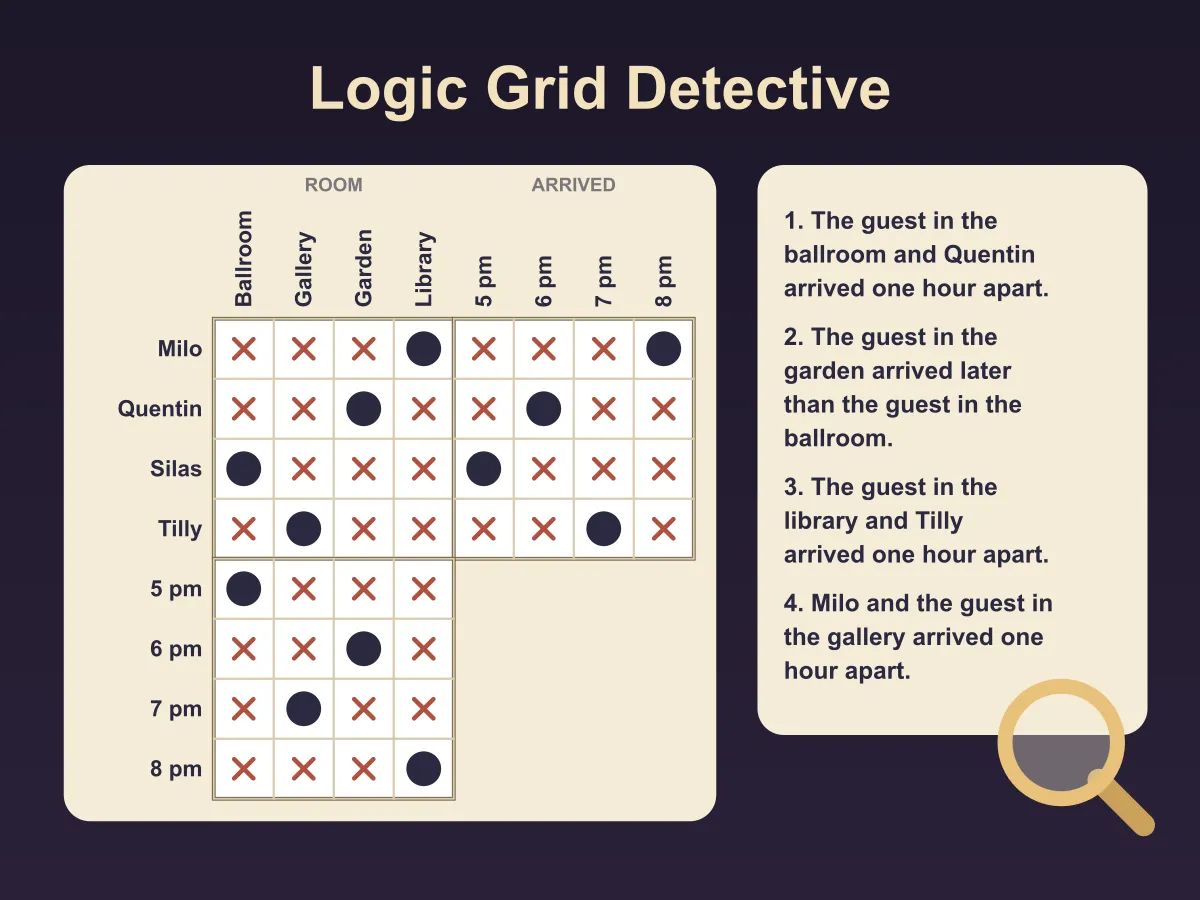
In a logic grid nobody lies; you only combine clues. In a find-the-impostor puzzle each person says one thing and the liar is the one false line. Here each suspect says three things, a liar may tell the truth in some of them, there can be two liars, and you also have to search the house for clue cards before the one account that fits becomes clear.