








Home / Reaction / Hide & Paint
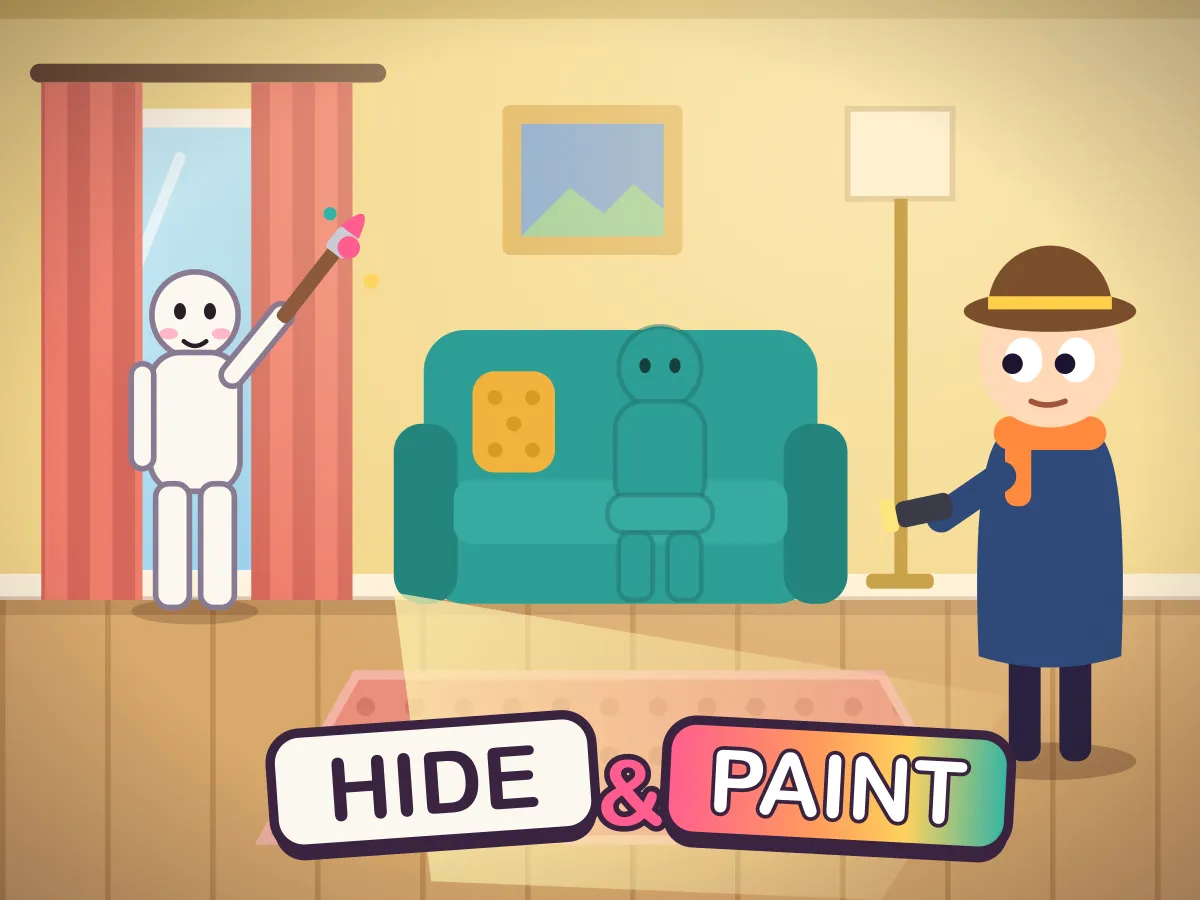
Hide & Paint is a free hide and paint game online: camouflage hide and seek that you play in your browser. Pick a hiding spot in a cosy room — in front of a striped curtain, on a teal sofa, beside a shelf of red books — then tap the wall behind you to pick up its exact colour with the eyedropper, choose plain, stripes or dots, and stand, sit or lean to fit the furniture. When the paint timer runs out, a seeker walks a route you were shown in advance, sweeping a torch across the room. Every second the beam rests on you without spotting you scores points, and a close call pays a bonus, but up close it needs a far better match than from across the room. Stay hidden for 60 seconds to open the next room: the Living Room, the Library and the Kitchen, each on Easy, Medium and Hard. Seek mode turns the game around: find five painted hiders before the clock runs out. No download, no sign-up, and it plays on a phone as well as a computer.
How to play Hide & Paint
- Press Play and choose Hide or Seek, a room and a difficulty. Only the Living Room is open at first; staying hidden for a whole round, or finding all five hiders, opens the next room.
- Hide mode starts with 30 seconds to paint (20 on Hard). Tap one of the numbered markers on the floor to stand on that hiding spot. The dotted line and the ghost with a torch show the route the seeker will walk this round.
- Tap any surface in the room — the wall, a curtain, the sofa, a row of books — to pick up its exact colour with the eyedropper. Then choose a pattern: Plain, Stripes or Dots. Patterns are drawn in line with the room, so the right one makes you melt into a striped curtain or a polka-dot drape.
- Choose a pose: Stand, Sit or Lean. Seats want you to sit, and so do low cupboards you can crouch in front of; tall, narrow things such as a lamp, a clock, a fridge or a pantry door want you to lean; flat surfaces want you to stand. The wrong pose costs 15% of your match.
- Watch the match percentage. It compares your paint with everything behind your silhouette, so a spot where you overlap two colours can never reach 100%. Press Hide! when you are happy, or the timer does it for you.
- The seeker walks its route for 60 seconds, sweeping its torch. While the beam is on you and you have not been spotted, you earn 10 points a second. Up close it needs a better match than at the far end of the beam.
- If your match is borderline, the seeker stops with a question mark and studies you through a magnifying glass. If your paint holds up, it shrugs and moves on: a close call worth 50 points. If not, you are caught — unless you swap away first.
- You get one swap per round, and it costs 30 points: tap Swap (or tap a marker twice) and pick another spot. Your paint stays the same, and if the torch is pointing at either spot when you move, the seeker sees you. Slipping away from a seeker that is studying you is worth 50 points.
- Seek mode: five painted hiders stand somewhere in the room. Tap one to catch it for 100 points. A tap where nobody is costs 20 points and fogs your magnifying glass for a second — longer if you keep missing. Find all five within 60 seconds for a bonus of 5 points for every second left.
Tips
- Read the route before you paint. The dotted path and the ghost show where the torch will sweep and how close the seeker will walk. A spot it sweeps often scores more, but it has to be painted better.
- Single-colour spots are the safest: the sofa in the Living Room, the armchair in the Library and the fridge in the Kitchen. Spots where your silhouette overlaps two things — the cushion on the sofa, the cupboards under the kitchen window — top out well below 100%.
- Tap right next to where you stand. The eyedropper takes the colour of exactly what you tap, so the sofa arm gives a darker teal than the sofa back, and the window frame is not the glass.
- Check the pattern. The curtains, the book spines, the grandfather clock, the TV cabinet and the pantry door are striped; the plant, the drapes and the library wallpaper are dotted. Plain paint on a striped curtain gives you away.
- Try each pose and watch the match number move. Sitting on the sofa or crouching in front of low cupboards often beats standing, and leaning suits anything tall and thin.
- The score rewards nerve. A spot the torch only reaches once is safe but scores little; standing where the beam lingers — with paint good enough for the close look — is how big scores happen.
- Save your swap. The best use is to start somewhere the seeker looks at a lot, bank the points, and slip to a safer spot before its closest look — while the torch points somewhere else.
- In Seek mode, scan slowly. Hiders give themselves away with a faint outline, a colour a shade off from what is behind them, a quick fidget with their eyes open, or on Easy and Medium sometimes the wrong pattern.
- Do not tap at random in Seek mode: every miss costs 20 points, and misses in a row fog the glass for 1, then 2, then 4 seconds — time you need to find the rest.
FAQ
How do you play Hide and Paint?
Stand on a hiding spot, tap the surface behind you to pick up its colour, choose the pattern and pose that fit, then press Hide! and hold still. A seeker walks around the room for 60 seconds sweeping a torch; you score 10 points for every second the beam is on you without spotting you. In Seek mode you are the one with the torch and have to find five painted hiders.
Is Hide & Paint free, and do I need to download anything?
It is completely free and runs in your web browser. There is nothing to download or install and no account to create.
Can I play Hide and Paint on my phone?
Yes. Every action is a tap, the layout fits an upright phone, a phone on its side, a tablet or a computer, and on a keyboard you can play with the arrow keys, E, the number keys and Enter.
Is Hide and Paint multiplayer?
No, it is a single-player game. The seeker in Hide mode and the five hiders in Seek mode are played by the computer, and your best scores are saved only in your own browser.
What does the seeker look at?
It compares your figure with whatever is behind your silhouette: the colour, whether the pattern is plain, striped or dotted, and whether your pose fits the furniture. The closer it stands, the better the match it needs. When it is unsure it stops with a question mark and studies you before deciding, and it always notices movement inside its torch beam.
How is the score worked out?
In Hide mode you earn 10 points for each second the torch is on you without spotting you, 50 for each close call (the seeker studies you and moves on, or you slip away while it looks), and lose 30 if you use your swap. In Seek mode each hider found is worth 100, each miss costs 20, and finding all five adds 5 points for every second left on the clock.
Why did I get caught?
The result screen tells you: wrong colour, wrong pattern or wrong pose, with your match and the match it needed from where it was standing — or that it saw you move because you swapped while its torch was on you or on the spot you moved to.
Can a white, unpainted figure ever survive?
No. Every hiding spot is swept by the torch at least once on every route, and paper white does not match anything in these rooms, so the seeker always finds an unpainted figure.
How many rooms and levels are there?
Three rooms — the Living Room with 7 hiding spots, the Library with 6 and the Kitchen with 5 — each on Easy, Medium and Hard. Every room has three different seeker routes, and a round picks one of them. Every route on every difficulty can be survived with the right spot and paint.
What changes on Hard?
You get 20 seconds to paint instead of 30, the seeker walks its route twice in a round, its torch is wider and reaches further, it needs about a 92% match up close, and it studies a suspicious spot for less time. In Seek mode the hiders’ paint is closer to the room, their outline is fainter, they fidget less often and they never pick the wrong pattern.