
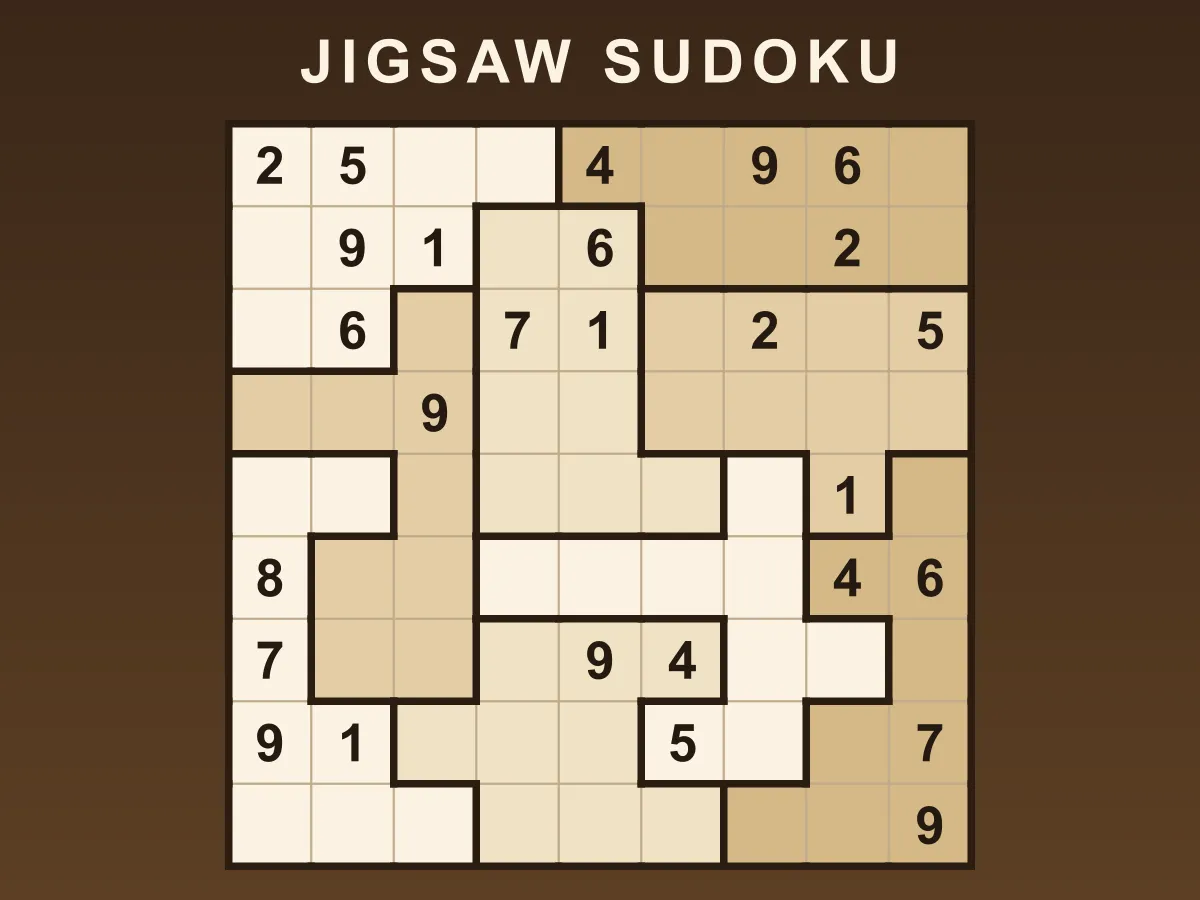
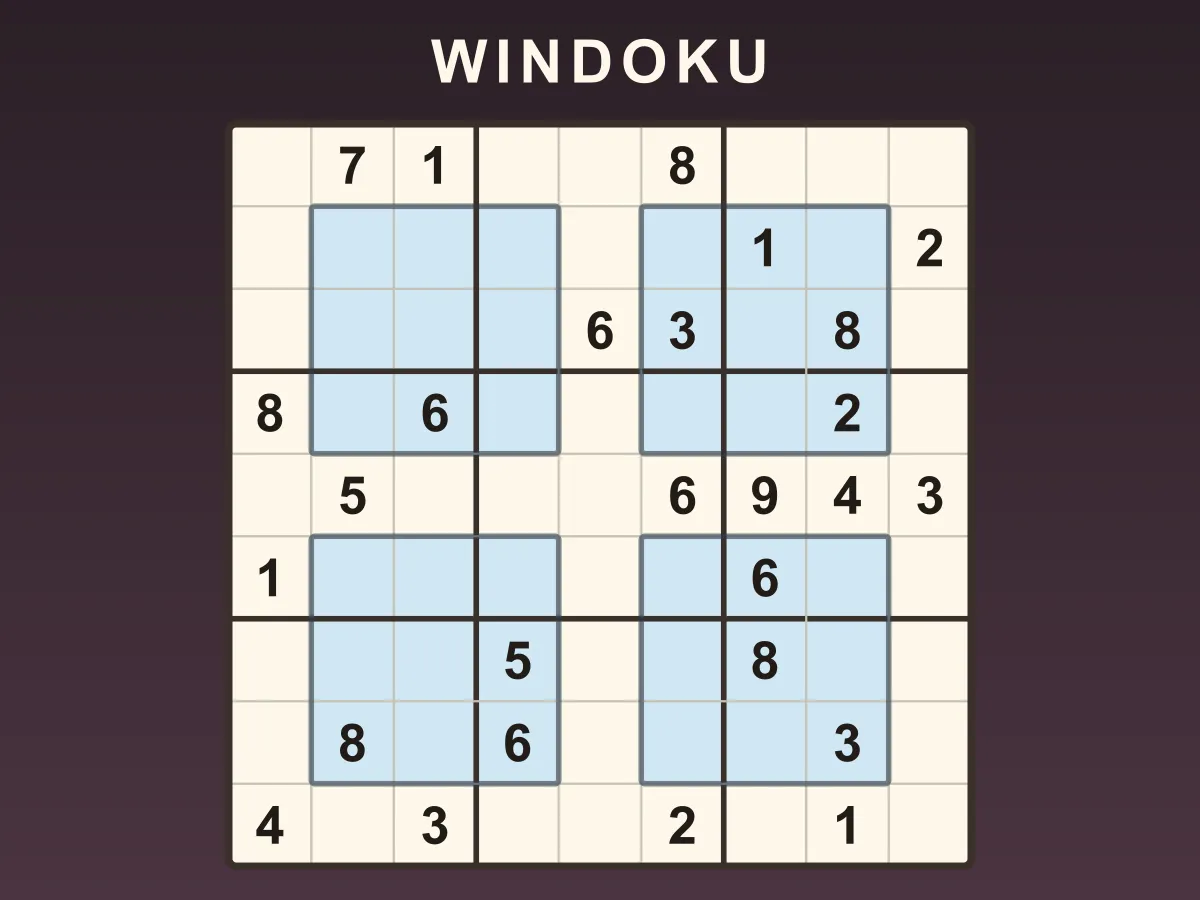


Jigsaw Sudoku, also sold as Irregular, Nonomino, Squiggly, Geometric or Chaos Sudoku, is a free online Sudoku variant with no 3×3 boxes at all. The 9×9 grid is cut into nine connected pieces of nine squares, and every row, every column and every piece must hold the digits 1 to 9 exactly once. The cut changes with every board, so reading the shapes is half the puzzle. Tap a square and pick a digit, or type it. Pencil in notes, undo, and spend up to three hints that explain their reasoning. Twelve levels run from 43 given digits down to about 18, ending on boards that need the jigsaw-only Law of Leftovers. Every board is generated, has exactly one answer, and is solved by logic alone before you see it. No download, no account.
How to play Jigsaw Sudoku
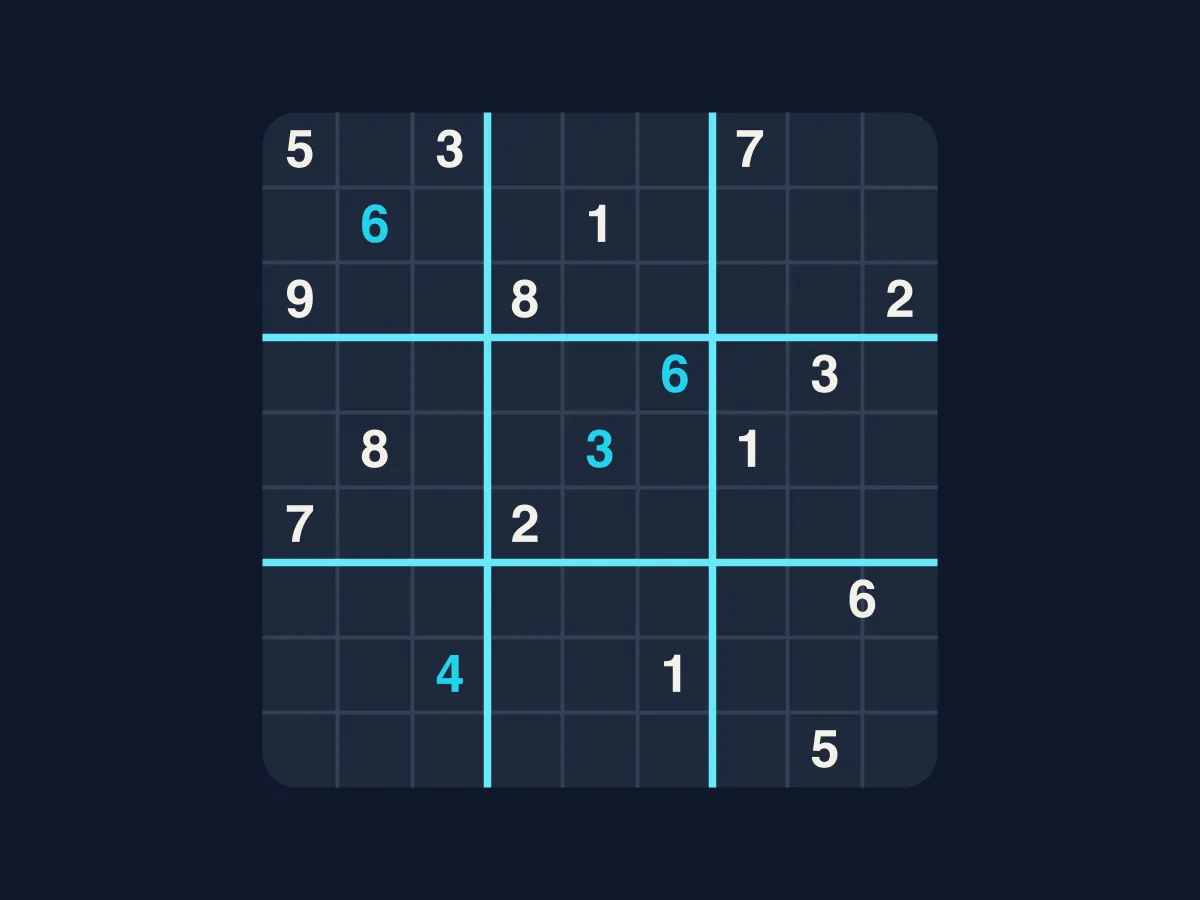
- The board is a 9×9 grid with no 3×3 boxes. Heavy dark seams cut it into nine jigsaw pieces of nine squares each, and each piece is printed on a slightly different shade of paper. The digits in black are given and cannot be changed.
- Fill every empty square with a digit from 1 to 9 so that every row, every column and every jigsaw piece holds each digit exactly once.
- Tap a square to select it, then tap a digit on the pad, or type it on a keyboard. The whole of the selected square’s piece lights up along with its row and column, so you can see the shape you are working inside. Arrow keys move the cursor, and Backspace, 0 or the ⌫ key clears a square.
- Turn on Notes (or press Space or N) to pencil small candidate digits into a square instead. Writing a digit clears it from the notes of every square in the same row, column and piece.
- A digit that appears twice in a row, a column or one piece turns red, so a clash shows at once — and in a jigsaw grid a clash inside a piece is easy to miss by eye.
- The puzzle is solved the moment every square is filled and nothing clashes. Undo steps back, Clear removes everything you added, and New Puzzle cuts another board on the same level.
- The ? button fills one square and says why: a wrong digit is put right first, otherwise it fills the next square that can be worked out from the board and names the row, column or piece that forces it. Three per board.
Tips
- Trace a piece before you place anything in it. A jigsaw piece can span four rows and four columns, so the squares that share a group with the one you are looking at are nowhere near the neat 3×3 block your eye expects.
- Hunt for the narrow pieces first. A piece squeezed into two or three columns already takes nine different digits out of those columns, which is the strongest single clue most boards hand you.
- A piece that fits almost inside one row or column is gold. If eight of its squares sit in rows 4 and 5 and only one sticks out, that one square has to hold whatever digit those two rows are missing.
- The whole of that idea is the Law of Leftovers, the step this variant has and ordinary Sudoku does not: take any band of whole rows (or columns) and the same number of pieces. Both hold every digit that many times, so the squares those pieces spill outside the band hold exactly the same digits as the squares of the band that belong to other pieces. The two little lists are usually one, two or three squares each, and matching them up solves spots nothing else will.
- From level 8, use notes. When a digit’s only places inside one piece all sit on one row, it cannot go anywhere else in that row — the same "lined up" step you use with boxes in ordinary Sudoku, except the overlaps are irregular and easy to overlook.
- On levels 10 and 11, look for pairs: two squares in one row, column or piece that can only take the same two digits. Those digits belong to those two squares, so cross them off everywhere else in that group.
FAQ
Is Jigsaw Sudoku free to play?
Yes. It runs in the browser with no download, no sign-up and nothing to buy. All twelve levels are included and unlock as you solve them, and New Puzzle cuts more boards on any level you have reached.
What is Jigsaw Sudoku?
It is Sudoku played on a 9×9 grid whose nine 3×3 boxes have been replaced by nine irregular connected shapes of nine squares. Rows and columns work exactly as in ordinary Sudoku: each holds 1 to 9 once. So does each piece. The same puzzle is published as Irregular Sudoku, Nonomino Sudoku, Squiggly Sudoku, Geometric Sudoku and Chaos Sudoku — the names differ, the rules do not.
How is Jigsaw Sudoku different from normal Sudoku?
Only the nine regions change, and that changes everything about how it feels. A box is always the same tidy 3×3 block, so you learn to read it at a glance; a jigsaw piece can stretch across four rows and four columns, and it is cut differently on every board, so you have to look at the shape rather than remember it. It also unlocks a step ordinary Sudoku has no use for, the Law of Leftovers, which the last level is built on.
Is this a picture jigsaw puzzle?
No. Nothing is dragged or fitted together: "jigsaw" describes the shape of the nine regions on a number grid, not a picture cut into pieces. If you want the picture kind, this site has a separate Classic Jigsaw Puzzle.
Does every puzzle have exactly one answer?
Yes, and it is checked rather than assumed. Each board is built from a complete grid, and a solver that only makes forced deductions — never a guess — has to finish it before it is shown, which means there is only one answer. The tests also count every possible answer by brute force and find exactly one. The irregular pieces are doing real work: read the same given digits as an ordinary 3×3-box Sudoku and they never have a single answer, usually none at all.
Will I ever have to guess?
No. Levels 1 to 4 need only one step: a digit with just one square left in a row, a column or a piece. Levels 5 to 7 also need a square with just one digit left. Levels 8 and 9 need digits that line up where a piece crosses a line, levels 10 and 11 need pairs of squares sharing the same two digits, and level 12 needs the Law of Leftovers. Each level ships boards that need its step and nothing harder.
What is the Law of Leftovers?
It is the solving trick that only jigsaw grids allow. Take a band of whole rows — say rows 1 to 3 — and any three pieces. The band holds every digit three times and so do the three pieces, so whatever those pieces hang outside the band must be the same digits as whatever the band holds that belongs to other pieces. The two groups are usually only one to three squares each. Press the hint button on level 12 and it rings both of them for you and names the band.
Can I play it if I am colour-blind?
Yes. The nine pieces are told apart by the heavy dark seams between them, which carry the whole cut on their own; the four paper shades behind them differ in lightness rather than in hue, so they stay just as distinct in greyscale as in colour.
Does Jigsaw Sudoku work on mobile?
Yes. Tap a square, then a digit on the pad under the board; the board fills the width of a phone held upright, and the pad sits under it. On a computer you can play with the mouse or entirely from the keyboard.