
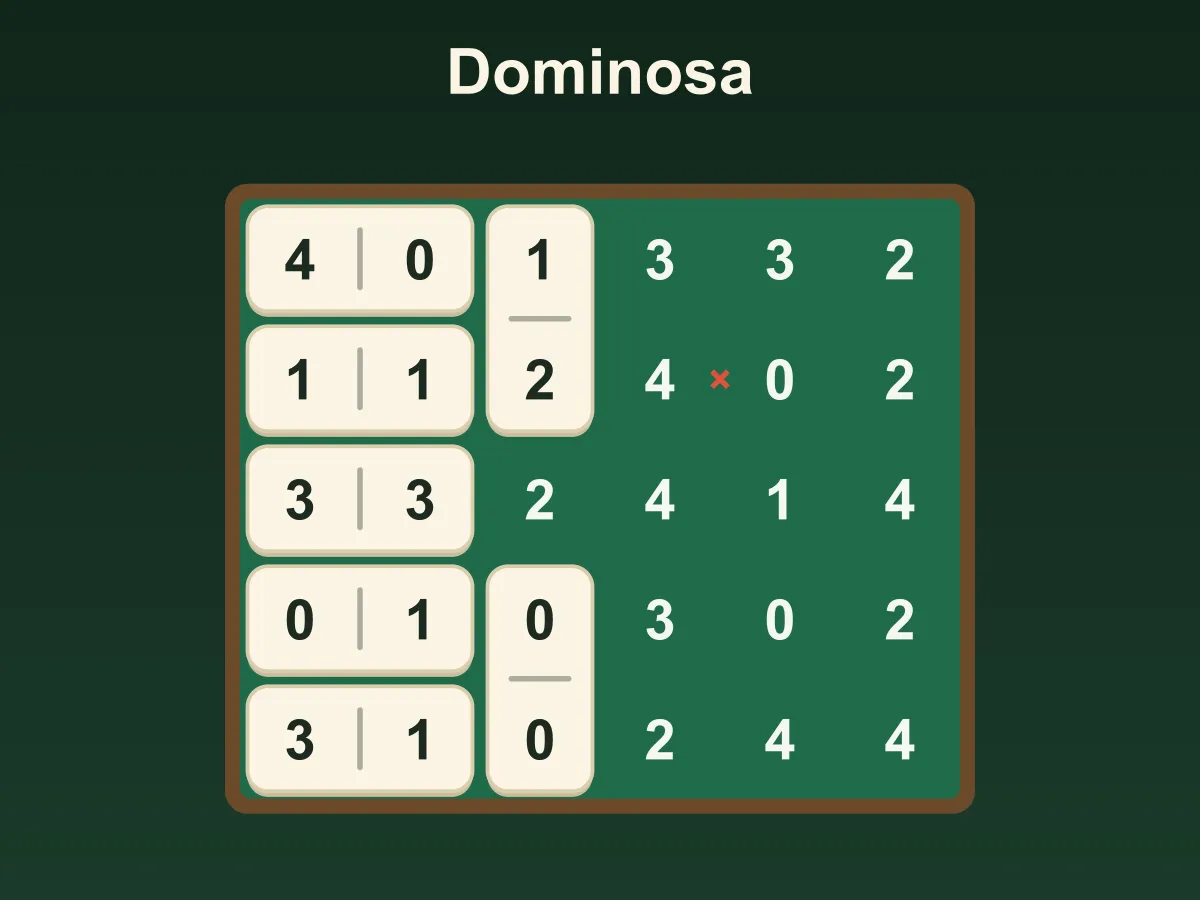



Dominosa is a free online logic puzzle played with a complete set of dominoes. Someone laid every tile of a double-n set face up on the table, packed tight into a rectangle, and then the outlines between the tiles vanished — only the numbers are left. Your job is to put the outlines back: cut the grid into dominoes, two neighbouring squares each, so that every tile of the set appears exactly once. A double-three set has ten tiles, from 0-0 to 3-3, on a 4×5 grid; the double-seven set on the last level has thirty-six. Drag across two squares to lay a tile, tap a tile to pick it up, and mark borders you have ruled out with a ✕. The checklist beside the board shows which tiles of the set you have found and flags any you have used twice, and tapping a tile in it lights every place on the board it could still go. Every board has exactly one answer and is proved solvable without guessing before you see it. Eight levels grow from the double-three to the double-seven set, and from level 5 on each board needs at least one "what if" followed through to a contradiction. No download, no account.
How to play Dominosa
- The grid is a complete set of dominoes laid face up with the outlines removed. A double-n set has one tile for every pair of numbers from 0-0 to n-n.
- Cut the whole grid into dominoes: two squares side by side or one above the other.
- Every tile of the set must appear exactly once. If 2-5 is on the board twice, one of them is wrong.
- Drag from a square to its neighbour to lay a tile there. Laying a tile over another picks the old one up, so moving a tile is one drag.
- Or tap a square, then tap the neighbour it pairs with. Tap a laid tile to pick it up.
- Rule out a border by marking it: switch on ✕ Mark and drag across it, or drag with the right mouse button. Marks are only notes; the game does not check them.
- The checklist shows the whole set. A tile turns ivory once you have laid it and red if you have laid it twice. Tap one to light every place on the board it could still go.
- On a keyboard, arrow keys move, Enter selects a bare square (or picks up the tile on a covered one) and the next arrow lays a tile from it that way. Shift+arrow lays a tile from the cursor at once, M switches marking on and off, and Backspace picks a tile up.
- The puzzle is solved when every square is covered and every tile of the set appears exactly once.
- Undo steps back one change, Clear wipes the board, and New Puzzle deals a different board on the same level.
- The ? button lays one tile of the answer, fixing a wrong one first. Three per board.
Tips
- Start with the checklist. A tile whose two numbers sit next to each other in only one place on the whole board has to go there.
- Corners and edges are your friends: a corner square has only two neighbours, so it can only belong to one of two tiles.
- Once a tile is laid, every other place that tile appears is out. Tap a tile in the checklist to light the places it can still go — once it is laid, only its own place stays lit.
- Watch for squares that would be stranded. If laying a tile would leave a neighbour with no free partner, that tile cannot go there.
- If every place a tile could still go touches the same square, that square belongs to that tile — and none of its other neighbours can pair with it.
- Use the ✕ marks generously. Ruling borders out is most of the work on the bigger sets, and a mark is cheaper to undo than a tile.
- On the later levels, try a tile in your head. If laying it leaves a square with nobody to pair with, or a tile with nowhere left to go, it is wrong.
- Doubles are special: a 4-4 needs two 4s side by side, and there are usually very few places that happens.
FAQ
Is Dominosa free to play?
Yes. It runs in the browser with no download, no sign-up and nothing to buy. All eight levels are included and unlock as you solve them.
What are the rules of Dominosa?
The grid holds a complete set of dominoes laid face up with the outlines removed. Divide it into dominoes — pairs of neighbouring squares — so that every tile of the set appears exactly once. A double-three set, for example, has ten tiles: 0-0, 0-1, 0-2, 0-3, 1-1, 1-2, 1-3, 2-2, 2-3 and 3-3.
Does every puzzle have exactly one answer?
Yes, and it is checked rather than assumed. Each board is dealt from a real set onto a real tiling, then edited until only one way of cutting it works, and finally solved by a program that only ever makes forced moves. The tests confirm every level with an exhaustive search as well.
Will I ever have to guess?
No. A board only ships if it can be finished by deduction alone. On levels 1 and 2 every move is direct — a square with one possible partner, or a tile with one possible place. Levels 3 and 4 need a step further, such as spotting that every place a tile could go touches one square. From level 5 on, each board needs at least one "what if": try a tile, follow it through, and watch it fail.
How many levels are there, and how hard do they get?
Eight, from the double-three set (10 tiles on a 4×5 grid) to the double-seven set (36 tiles on 8×9). In testing, the number of "what if" steps a board needs rose from about one on level 5 to about five on level 8. New Puzzle deals a fresh board on any level you have reached.
What are the ✕ marks for?
They are notes for you: a ✕ on a border means you have decided no tile lies across it. The game never checks them and they do not count toward solving, but on the bigger sets they save you from re-checking the same border over and over.
Is this the same as the Dominoes game on this site?
No. Dominoes is the table game against an opponent, matching ends of a chain. Dominosa is a solo logic puzzle: there is no opponent and no chain, just a board of numbers and one way to find the whole set in it.
Does it work on a phone?
Yes. Drag with a finger across two squares, or tap one and then its neighbour; tap a tile to pick it up. On a phone held upright the checklist moves under the board and the game uses a taller frame, so even the double-seven board keeps squares large enough to hit.