
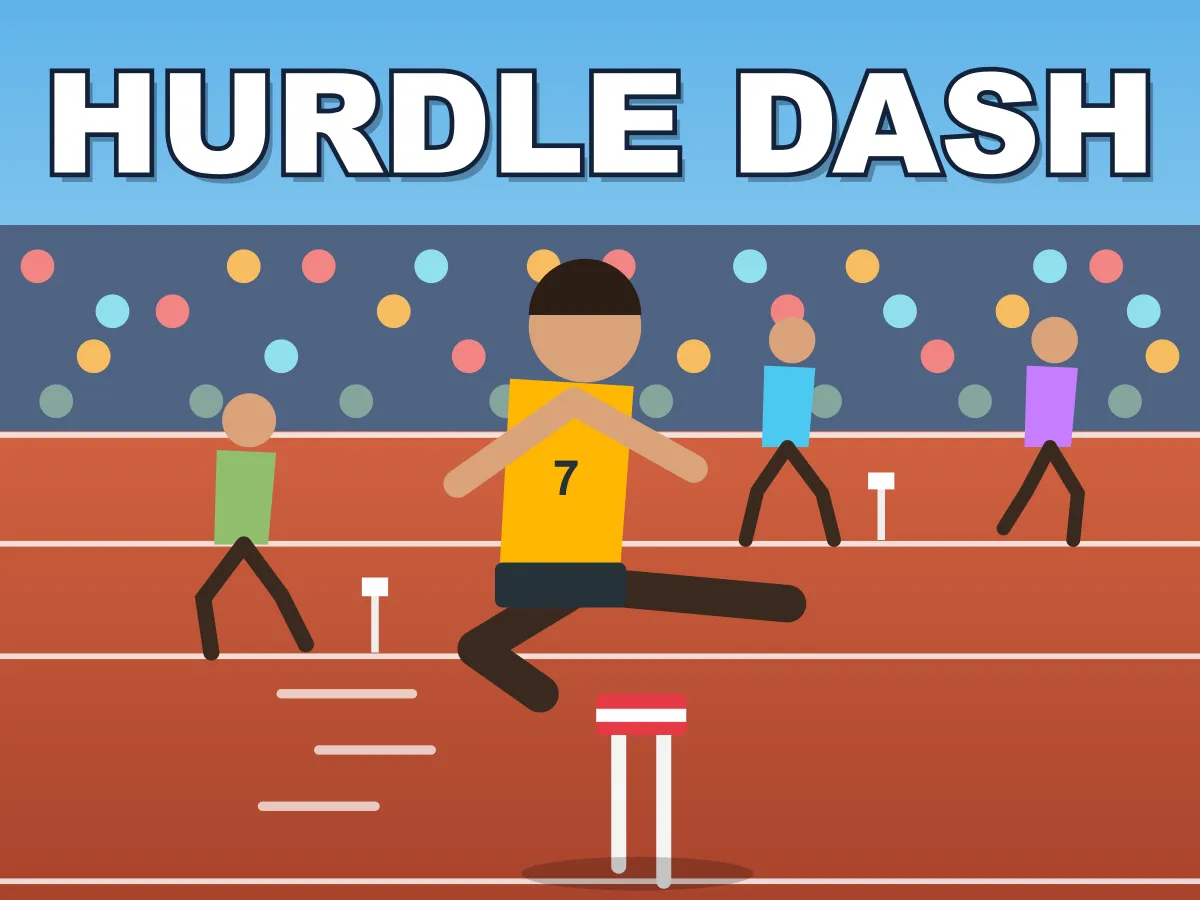





Hurdle Dash is a free online hurdles game. Your runner sprints down the lane on their own; your job is the jump. Tap Space, the up arrow or the screen just before each hurdle and the runner strides over it — time it so the lead foot skims the bar at the top of the stride and it is a perfect clear, and every perfect in a row winds your top speed up a little more. Jump too late and you clip the hurdle and lose speed; leave it far too late and you go down. Hold the jump for a long bound to fly a water jump and its pool. Twelve stages run from eight low hurdles to the 110 metres, high hurdles, odd gaps, doubles, water jumps, a fast lane, one lap of the 400 metres, a dusk race under fading floodlights, a steeplechase and a grand final — always against three rivals in the next lanes. Works on a phone, a tablet or a computer — no download, no sign-up.
How to play Hurdle Dash
- Pick a stage and press Start, Space, or tap the screen. The starter calls “On your marks… set…” and the gun goes; from then on your runner sprints by themselves and picks up speed towards the stage’s top speed.
- Jump each hurdle: press Space or the up arrow, or tap anywhere on the track, just before you reach it. A tap is a hurdle stride, 0.4 seconds in the air and 0.4 metres up at its highest. What counts is your lead foot as it passes over the bar.
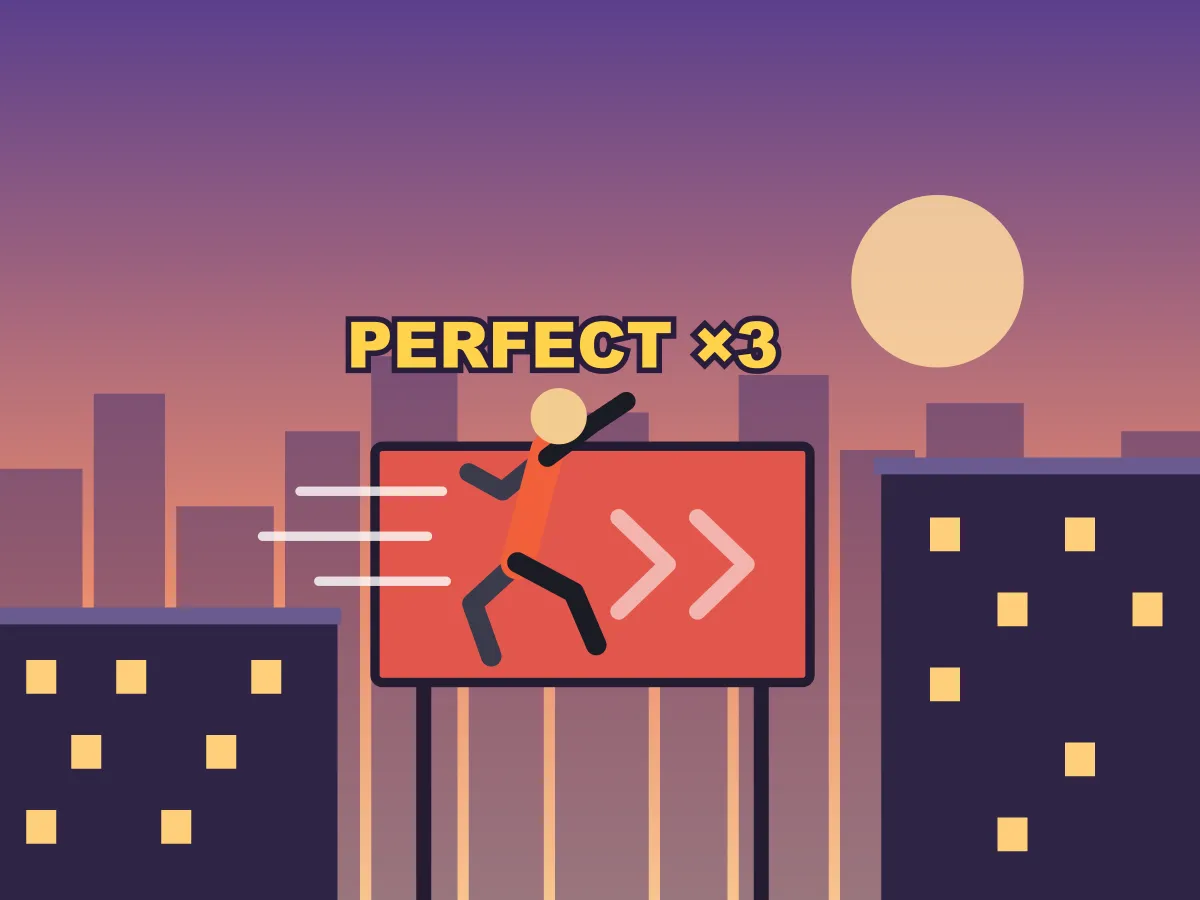
- Foot near the top of the stride as it crosses: a perfect clear. A little lower but over: clean. A little low: you clip the hurdle, it goes down and you lose a fifth of your speed. Well short, or no jump at all: you fall over it, and it takes almost a second to get up and start running again from a standstill.
- Every perfect in a row adds 2.5 percent to your top speed, up to six in a row; a clean clear keeps your rhythm, a clip, a fall or a splash loses it. Jumping where there is nothing to clear breaks your stride and costs some speed.
- For a water jump — a barrier with a pool behind it — keep holding the jump past its first eighth of a second: your runner hangs in a long bound that clears the barrier and the pool. A tap lands you in the water, which costs more than half your speed. A long bound over a plain hurdle works too, but lands a little heavier.
- Run the stage’s goal time to clear it and open the next stage; the faster times on the start card earn the second and third stars. Your three rivals — Pip, Jo and Ace — run the same hurdles in the next lanes.
Tips
- Watch the hurdle, not the clock: the right moment to jump is a distance from the bar, and it comes sooner as your rhythm builds speed. When you run faster, jump a touch earlier.
- High hurdles are only just under a tap’s highest point, so a tap has to be close to perfect to clear them. If you keep clipping, hold for a long bound — it clears with room to spare but costs a little speed on landing.
- On doubles, press again as soon as you land. A press a moment too soon is kept for 0.15 seconds and fires the instant your legs are ready, so there is no need to wait for the landing.
- A fall costs far more than a clip. If you are unsure, jump a touch early rather than late — an early jump clips at worst, a very late one puts you on the ground.
- On the dusk stage the floodlights only reach a few strides ahead. Keep your eyes at the edge of the light and be ready the moment a hurdle appears.
- In the 400 metres the legs tire on the home straight, so the last hurdles come up slower than the first. Do not jump for them on the rhythm of the early ones.
FAQ
Is Hurdle Dash free to play?
Yes. Hurdle Dash is completely free to play online, with no download, no account and no in-game purchases.
How do I jump, and when?
Press Space or the up arrow, or tap the screen, just before your runner reaches a hurdle. The jump is judged the moment your lead foot passes over the bar: near the top of the stride is a perfect clear, a little lower is clean, lower still is a clip, and well short is a fall.
What is a perfect clear, and why does it matter?
A perfect clear is one where your lead foot skims the bar near the top of the stride, so you took off at just the right spot. Every perfect in a row adds 2.5 percent to your top speed, up to six in a row; a clean but not perfect clear keeps the rhythm, while a clip, a fall or a splash loses it. On a fast stage that rhythm is often the difference between two stars and three.
How do I get over the water jump?
Hold the jump. Keep Space, the up arrow or your finger down past the first eighth of a second and your runner hangs in a long bound that clears the barrier and the pool behind it. A tap lands in the water, which costs more than half your speed.
Are the hurdles in the real places?
On the 110 metres stages that keep the real layout, yes: 13.72 metres to the first hurdle and 9.14 metres between the ten of them. The 400 metres stage uses 45 metres to the first and 35 between. Other stages change the gaps, add doubles and water jumps on purpose.
Is every race possible without a single mistake?
Yes. Before a race is dealt, a simulated pilot runs it through the game itself, taking off in the middle of every clean window, and the race is only dealt if the pilot clears every hurdle without a clip, a fall or a splash.
Can I just keep jumping without looking?
No. Jumping blind at a steady pace — anywhere from every quarter of a second to every second and a half, tapping or holding — beat a stage’s goal time in fewer than one race in ten on every stage when we tested it. Every jump over nothing breaks your stride, and the hurdles still need the right moment. Never jumping at all means falling over every hurdle and never clears a stage.
How are the goal and star times set?
They are measured, not guessed. Three simulated runners — casual, regular and sharp, with human-like timing spread, lapses and reaction times — run every stage 41 times. The goal is the time a set share of the casual runner’s races beat, from 95 percent on the first stage to half on the last; two stars is the regular runner’s middle time, and three stars the sharp runner’s.
Who are the rivals?
Pip, Jo and Ace are those same three simulated runners — casual, regular and sharp — running your hurdles in the next lanes. Ace runs about the pace three stars ask for, Jo about two stars’ pace.
Does my screen’s frame rate change the race?
No. The race runs at a fixed 120 steps a second whatever your screen does, and each press is placed by its own timestamp, so the same presses give the same race at 60, 75 or 144 frames a second.
Can I play with the sound off, and on a phone?
Yes to both. Every sound — the gun, the jumps, the clips, the splash — has a picture on screen too. On a phone, tap anywhere on the track to jump and keep your finger down for a long bound; it plays held upright or sideways.
How is this different from Track Sprint?
Track Sprint is a three-event meet where you run by tapping your feet in rhythm. In Hurdle Dash your runner runs on their own and the whole game is the jump: reading each hurdle, choosing a stride or a long bound, and chaining perfect clears for speed over twelve hurdle races.