







Home / Reaction / Spider Climb
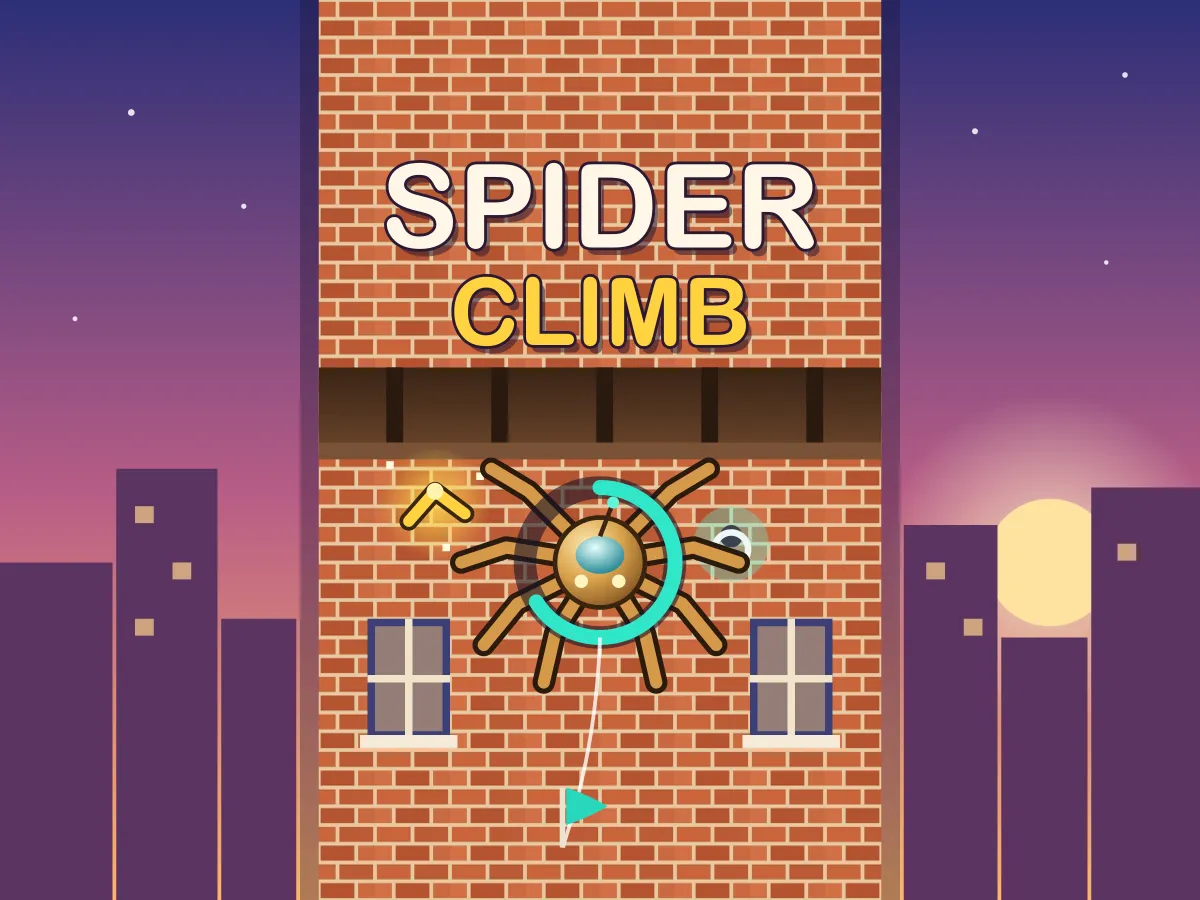
Spider Climb is a free spider climbing game you play online, in the browser, with no download. You ride a brass clockwork spider up the outside of a tower: hold your finger above it and it crawls toward you, let go and it clings on and rests. Every move spends grip, and the grip ring round the spider shows how much is left. Bricks are where you rest — the ring refills in a couple of seconds — but overhangs, roof eaves and moss give you nothing to hold still on, so you have to arrive at each one with enough grip to cross it in one go. Run out and the spider lets go; its silk line swings it back to the last flag. The hook is the arms: the rig starts with two, every wall has one more waiting on its route, and each arm makes the grip bar longer. Six golden arms hide on risky ledges, and each one stays on your rig for every wall after it — by the moonlit thirteenth tower you are steering a clanking, many-armed machine. Three difficulties change how fast grip drains, and each wall has a three-star time to chase.
How to play Spider Climb
- Press Play. Your clockwork spider waits at the foot of the first wall, with a grip ring around it and a grip bar in the top corner. The top of the wall, under the bunting, is where you are going.
- Hold your finger (or the mouse button) a little above the spider and it crawls toward that point; keep holding and drag to steer. Let go and it holds still. A quick tap sends it to that spot and it stops there on its own. On a keyboard, the arrow keys or WASD climb and Space stops.
- Every second of crawling on brick costs one second of grip, and the spider starts the first wall with four seconds of it. Holding still on brick refills 40% of the bar every second, so a full refill takes two and a half seconds.
- Overhangs, roof eaves and moss are the dangerous parts. Crawling across them costs more grip — eaves 2.4 times as much as brick, moss three times — and holding still on them keeps draining instead of refilling. Rest on the last brick below them, then cross in one go.
- Bolts clip you on as you pass: the first touch of each bolt tops the bar up by 40%, and a bolt is the fastest place to rest. Chimney braces are cheap to crawl through and refill quickly too.
- Pale cracked bricks give way 1.1 seconds after you first touch them, so cross them without stopping. Drip columns are slick for 1.2 seconds out of every three — watch for the drop gathering at the gutter and cross in the dry spell.
- If the grip ring empties, the spider lets go. Its silk line swings it back to the last flag you touched with a full bar, and the clock keeps running. Arms you have already picked up stay on the rig.
- Each wall has one arm on its route. Picking it up adds a leg to the spider and half a second to the grip bar, and it arrives full. Six walls also hide a golden arm off the easy line; a golden arm stays with you for every later wall.
- Reach the top row to finish the wall. Your time decides the stars, and finishing opens the next wall. Pick any wall you have reached from the list, and switch between Easy, Normal and Hard at any time.
Tips
- Rest on the last brick, not the first. Grip only matters for the stretch you cannot rest on, so climb the easy bricks at full speed and stop right below the eave or the moss.
- Rest only as much as the next stretch needs. A three-row eave costs about four and a quarter seconds of grip on Normal — if the bar already holds that with a little to spare, go now; topping up to full costs time you do not need.
- Stop on bolts when you can. A bolt refills the whole bar in one second, two and a half times faster than brick, and it tops you up the moment you touch it.
- Read the flag before a long wall. From wall five on, holding on all the way up from a flag runs the grip out before the stretch above it — the walls are built so that a rest on the way is the only way up.
- Go round moss when the detour is short. Moss costs three times as much grip per second as brick and slows you down too, so two extra bricks round the edge cost less grip than one square straight through it.
- Take golden arms early in the climb. A golden arm is half a second of grip on every later wall; picked up on wall three, it shortens the rests on ten walls after it.
- Never stop on a cracked brick. It gives way 1.1 seconds after you first touch it whether you are moving or not, so rest on the solid brick before the band.
- On drips, wait for the drop. A gathering drop at the gutter means that column is about to run; the wet spell lasts 1.2 seconds, then the column is dry for 1.8.
FAQ
Is Spider Climb free to play?
Yes. Spider Climb is completely free to play online in your browser: no download, no account and no in-game purchases. Every wall, arm and difficulty is open to everyone.
How do you play Spider Climb?
Hold your finger or mouse above the spider and it climbs toward it; let go and it clings on and rests. Every move spends grip and resting on brick refills it. Get to the top row of each wall before the grip ring runs out — rest on brick before overhangs, eaves and moss, because you cannot rest on those.
What happens when the grip runs out?
The spider lets go and its silk line swings it back to the last flag you touched, with a full grip bar. Nothing is lost except time: the clock keeps running through the fall, and any arms you have already picked up stay on the rig.
What do the arms do?
Each arm adds half a second of brick-climbing to your grip bar, so the bar literally gets longer and you need fewer rests. The spider starts with two arms and every wall has one more on its route, so it brings one extra arm to each wall after the first.
What are golden arms?
Six walls — 3, 5, 7, 9, 11 and 12 — hide a golden arm on a ledge off the easy line. It is a detour, but a golden arm is permanent: it stays on your rig for every wall after the one you found it on, as well as for the rest of that wall.
Can I just hold up and climb straight to the top?
On the first three walls, yes — the bolts keep you going. We tested a climber that holds on the whole way and never rests: it gets up walls one to three, and from wall five on it runs out of grip every single time. After that you have to pick your resting brick.
How many walls are there, and how long does it take?
There are thirteen walls, from a garden wall at golden hour to an antenna tower under the moon. On Normal, our careful test climber takes under ten seconds on the first wall and about 23 on the last; most players need a few tries on the later walls.
How do stars work?
Stars come from your time. Three stars means finishing within 5% of our careful test climber, which rests just enough before every stretch; two stars means within half again of its time. The times are shown in the bar at the top, and they are different on Easy, Normal and Hard.
What changes between Easy, Normal and Hard?
Only how fast grip drains: Easy drains a quarter slower than Normal and Hard drains 30% faster. Resting refills at the same speed on every setting. In our tests the same clumsy climber fell about four times as often on Normal as on Easy, and more than twice as often again on Hard.
Can I play Spider Climb on my phone?
Yes. It is built for touch: hold a thumb above the spider to climb and lift it to rest. It plays upright or sideways, and on a computer you can use the mouse or the arrow keys.
Is my progress saved?
Yes, in your own browser. The walls you have reached, your best time and stars on each difficulty, and your golden arms are kept on this device. Nothing is sent anywhere, and there is no account.
How is this different from other climbing games?
Most climbing games test timing or physics. In Spider Climb the challenge is grip: a budget you spend by moving and earn back by resting, on surfaces that change both. Choosing where to stop and how long to rest is the whole game — and the spider grows a new arm on every wall.