




Rage Climb is a free online hammer climbing game with exactly one move. There is no jump and no walk: you put the hammer head against something solid, drag away from it and release, and the drag becomes an impulse on your body. Aim well and you land on the ledge above; aim badly and you come down, keeping whichever shelf catches you rather than the one you were reaching for. That is the whole loop, and it is why a climb that takes a reference solver six pulls can take a person a great many more. Three mountains, each taller and narrower than the last, with a gauge beside the wall that marks the highest point you have reached so the ground you give back is impossible to miss. Every gap has been solved rather than guessed at: the launch speed needed for each ledge is computed from the ballistics, so nothing here is out of reach. No download, no account.
How to play Rage Climb
- You start resting on the bottom ledge. There is no jump, no walk and no mid-air control.
- Press anywhere and drag. The dashed line shows the launch the current drag would give you.
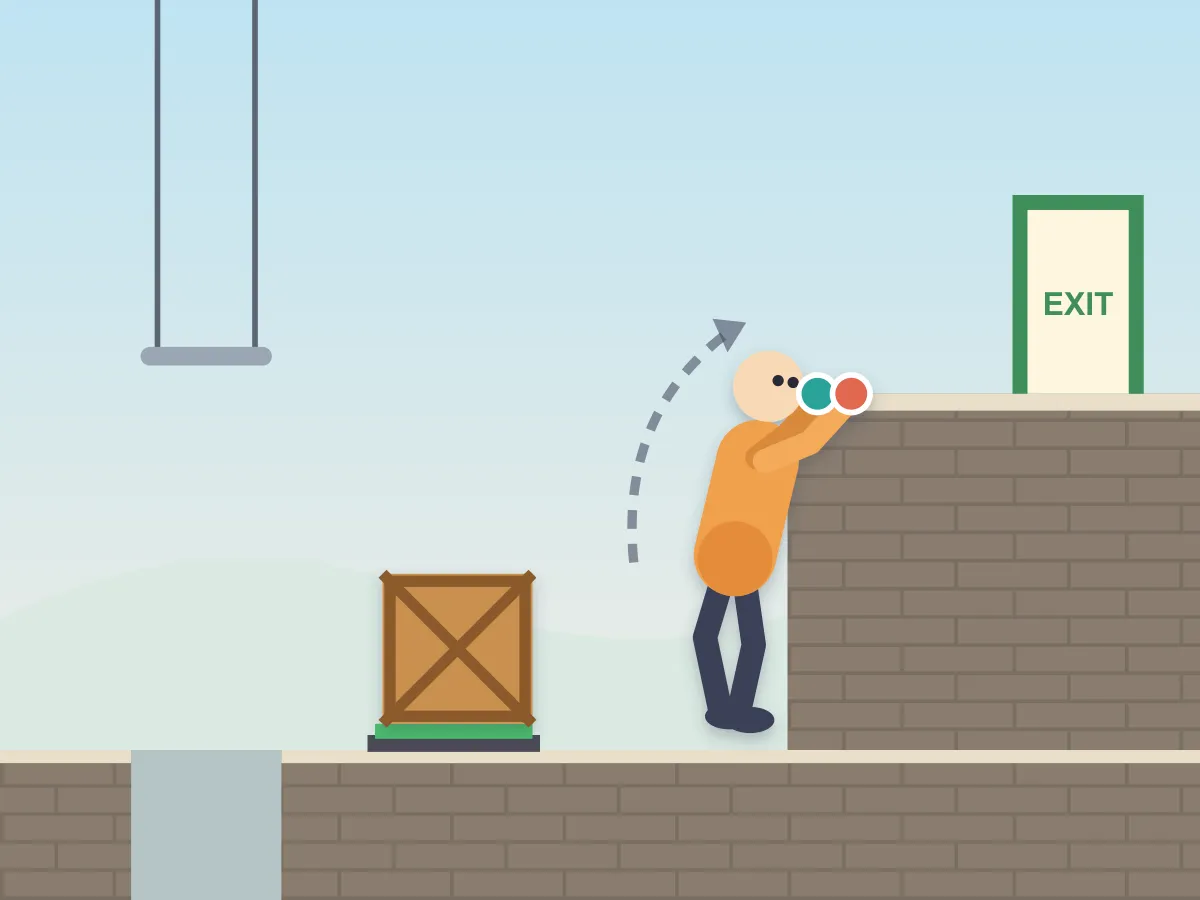
- Release to pull. Your body flies opposite to the drag, so drag down-left to go up-right.
- The longer the drag, the stronger the launch, up to a maximum — the hammer only has so much in it.
- A pull only works while the hammer can reach something solid. In mid-air it does nothing at all.
- Land on the ledge above and you keep the height. Miss and you fall to whatever catches you.
- The gauge beside the wall fills with your current height, and the gold notch marks the highest you have been.
- Falling all the way down is not a loss. The bottom ledge is always a place the climb can start again from.
- Reach the flag on the top ledge before the clock runs out to finish the mountain.
- Finishing with half the clock left is three stars, so the climb rewards clean pulls rather than many of them.
Tips
- Drag away from where you want to go. It is the opposite of steering and it is the single thing to get used to.
- Watch the hammer, not your body. It lights up when it can reach something — that is the only moment a pull will do anything.
- Aim for the middle of the ledge above, not its edge. The edge is where a slightly weak pull becomes a long fall.
- A slightly-too-strong pull is usually safer than a slightly-too-weak one, because overshooting a wide ledge still lands on it.
- Let yourself settle before pulling again. A pull taken while still bouncing starts from a position you have not read yet.
- The gold notch on the gauge is there to be beaten, not to be mourned. Falling below it costs seconds, not the run.
- On the narrow mountains, take the pull that reaches the next ledge rather than the one that reaches two. There is no partial credit for height you cannot stand on.
- If you keep falling from the same spot, change the angle rather than the strength. Most misses are aimed wrong, not thrown wrong.
- The clock is generous on purpose. Spend it reading the gap instead of pulling immediately.
FAQ
Is Rage Climb free to play?
Yes. It runs in the browser with no download, no sign-up and nothing to buy. All three mountains are included and unlock as you climb them.
How do I move? There is no jump button.
That is the game. Drag anywhere and release: the drag becomes an impulse on your body pointing the opposite way, as though you had shoved off the rock with the hammer. Drag down and left to be thrown up and right. Nothing else moves you, which is why every metre of height feels earned and every mistake costs some of it back.
Why did my pull do nothing?
Because the hammer could not reach anything solid. A pull needs something to push against, so it only works from a ledge or while touching one — in mid-air there is nothing to lever off and the drag is ignored. The hammer is drawn lit when it can reach and dim when it cannot.
Can I get permanently stuck?
No, and it is checked rather than hoped for. Every ledge on every mountain is used as a starting point in the test suite and the climb has to be completable from each one, so whatever catches you after a fall is somewhere the climb can resume. Falling all the way to the bottom is the worst case and the bottom is always climbable.
Is every gap actually possible?
Yes, and this is the one thing a climbing game like this cannot afford to leave to judgement. The minimum launch speed to get from one ledge to the next is a closed-form result — the square root of gravity times the rise plus the straight-line distance — so it is computed for every consecutive pair and required to be comfortably under the strongest pull the hammer can give. A gap needing more would stop the climb forever and would look merely difficult. The first set of physics constants failed that check on all three mountains and were changed because of it.
Does falling reset the level?
No. You keep whatever ledge catches you and the clock keeps running, so a fall costs time and height rather than the attempt. The gold notch on the gauge stays at the highest point you reached, which is either encouraging or the opposite depending on the fall.
How many pulls should a mountain take?
A solver that always aims with the minimum-speed solution needs about one pull per ledge — three, five and six on the three mountains. A person will take considerably more, and that gap is the game. The tests require the solver to use at least one pull per ledge, so no mountain can be cleared by a single lucky throw.
Does it work on a phone?
Yes, and portrait is the better shape for it. The mountains are tall and narrow, so the taller frame shows more of the climb, and dragging with a thumb is exactly the input the game wants.