
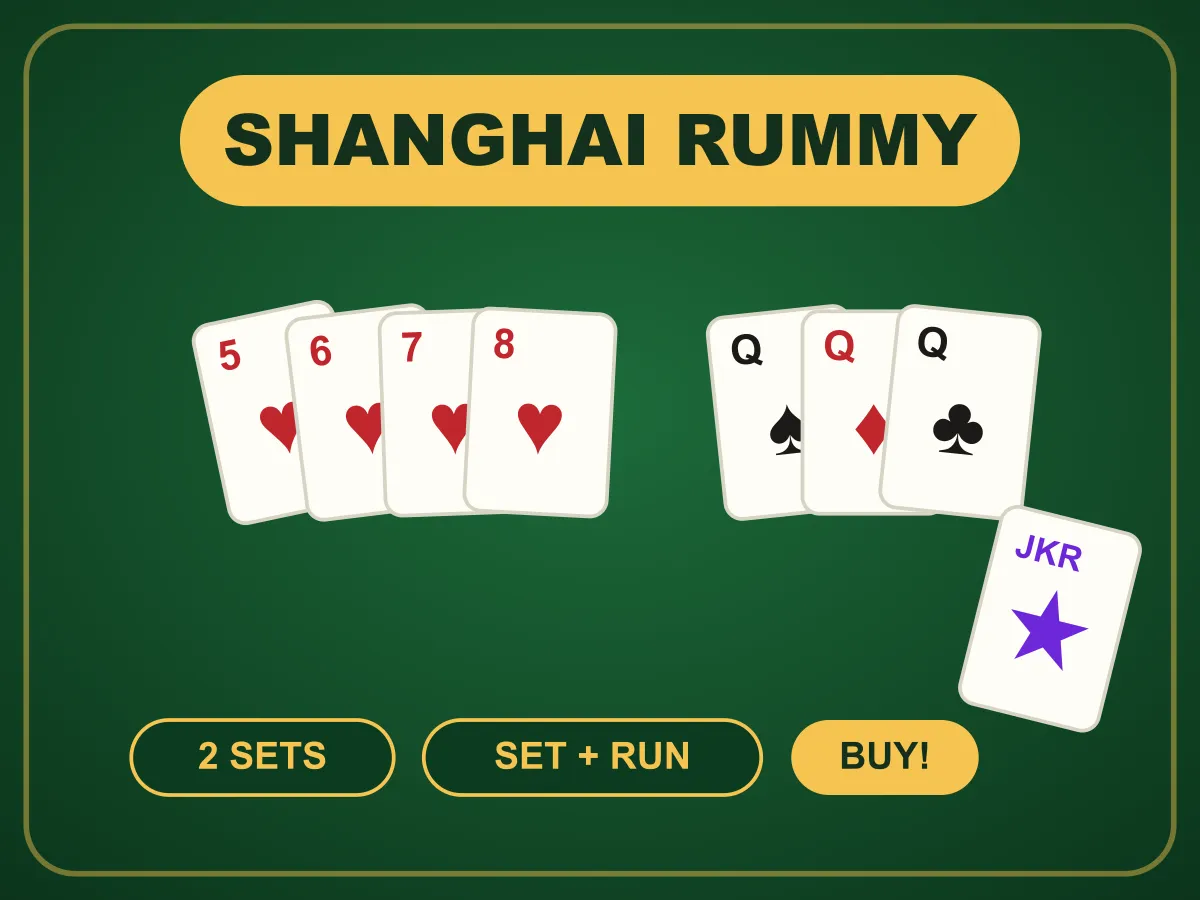


Shanghai Rummy is a free online contract rummy game for you and two or three computer players. Two packs and four Jokers are shuffled together, everyone gets eleven cards, and each of the seven deals has its own contract — two sets, then a set and a run, two runs, three sets, two sets and a run, a set and two runs, and finally three runs. Nothing goes on the table until you can put the whole contract down at once; after that you lay off on anyone’s melds and race to empty your hand. Pass on the upcard and any player further round the table may buy it, with a penalty card off the stock. Cards left in hand count against you, and the lowest total after seven deals wins. No download, no sign-up, and it plays on a phone.
How to play Shanghai Rummy
- Choose 3 or 4 players and Relaxed or Sharp computer opponents, then press Deal. Everyone gets eleven cards from two packs plus four Jokers, and one card is turned face up as the upcard.
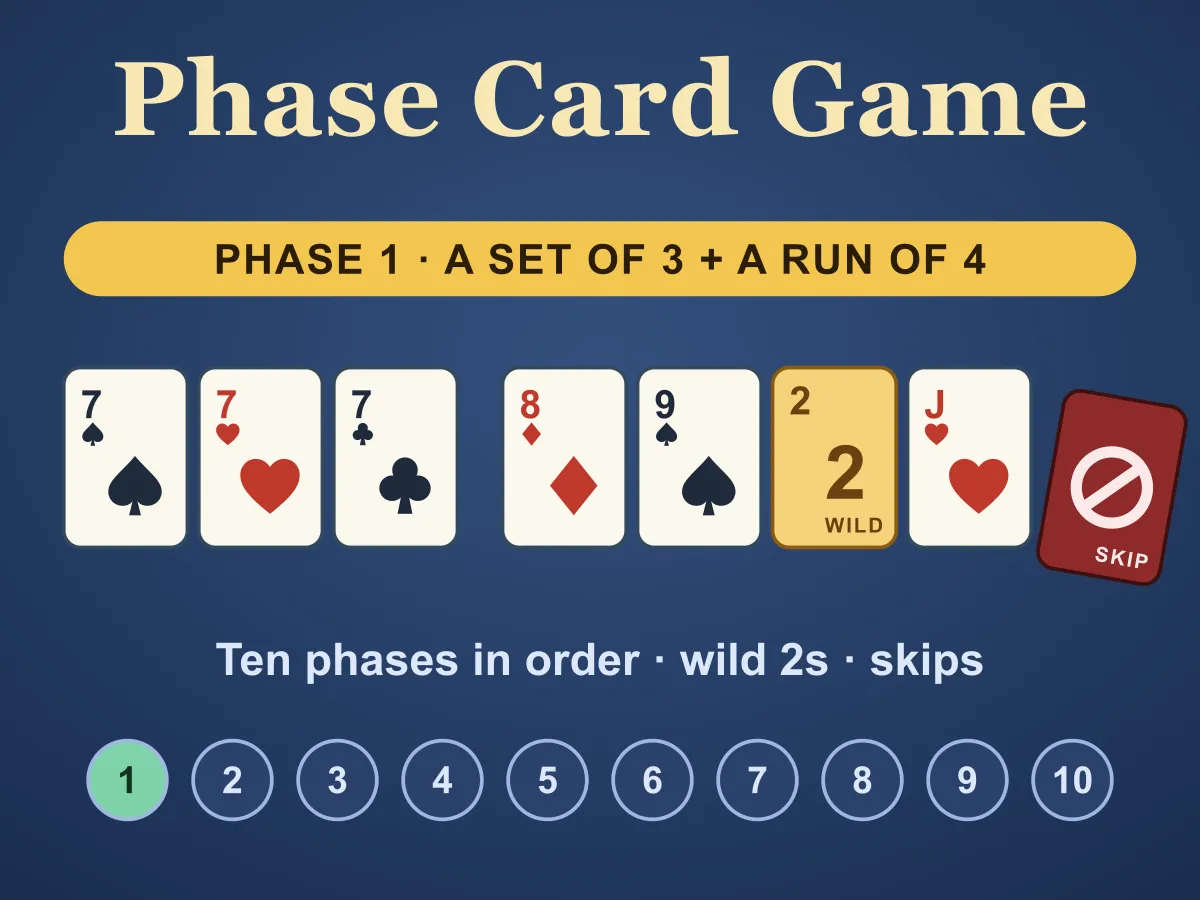
- Each deal has a contract shown at the top: deal 1 is two sets, then one set and one run, two runs, three sets, two sets and a run, one set and two runs, and three runs in deal 7. A set is three or more cards of one rank; a run is four or more cards in order in one suit.
- On your turn, draw from the stock or take the upcard. If you draw from the stock, a player further round the table who has not gone down may buy the upcard — they take it plus a penalty card from the stock. You have three buys each deal; when a card is offered to you, Buy and Pass buttons appear.
- When your cards make the whole contract, select them and press Go down — the game sorts them into sets and runs. Jokers are wild, but a meld may not hold more Jokers than natural cards.
- Once you are down, select a card and tap a highlighted meld (yours or anyone’s) to lay it off; a natural card can also take the place of a Joker in a run, and the Joker comes back to your hand. End each turn by discarding one card.
- The first player with no cards left goes out and ends the deal. Everyone else scores the cards they still hold — 5 for a two to nine, 10 for a ten to king, 15 for an ace and 25 for a Joker. After seven deals, the lowest total wins.
Tips
- Count what you need before you draw. Taking the upcard only makes sense if it brings the contract closer — otherwise it tells the table what you are collecting and the stock is a free guess.
- Buy early, not late. A buy costs a penalty card and two more cards to get rid of, so it pays when you are still short of the contract, and is a liability once you are close to going out.
- Runs are harder to finish than sets but easier to grow. In the run deals, keep three-card stretches of one suit with a gap (5-6-8) — one card or a Joker closes them, and every card above or below lays off later.
- Save your Jokers for the contract. A Joker that fills the run you cannot otherwise make is worth far more than one used to stretch a set, and one left in your hand costs 25 points.
- Once you are down, shed points first. Aces and Jokers are the costly cards to be caught holding; throw tens and court cards before small ones if nothing on the table will take them.
- Watch who is down. A player who has gone down cannot buy, so the cards you pass only help the players still building their contract — and a player with two or three cards left is about to go out.
FAQ
Is Shanghai Rummy free to play?
Yes. Shanghai Rummy is completely free to play in your browser, with no download, no account and nothing to buy. It works with a mouse, a touchscreen or the keyboard, on a computer, tablet or phone.
What are the contracts in Shanghai Rummy?
This version plays seven deals: (1) two sets, (2) one set and one run, (3) two runs, (4) three sets, (5) two sets and one run, (6) one set and two runs, and (7) three runs. A set is at least three cards of one rank in any suits; a run is at least four cards of one suit in order. You must put the whole contract down in one turn, and the melds may be longer than the minimum.
How does buying work in Shanghai Rummy?
When the player whose turn it is draws from the stock instead of taking the upcard, the upcard is offered round the table in turn order to everyone who has not gone down. The first to accept takes it plus one penalty card from the top of the stock. Each player may buy three times per deal. If nobody buys, that card is buried and out of play.
How is Shanghai Rummy scored?
The player who goes out scores nothing for the deal. Everyone else counts the cards still in their hand: 5 points for each two to nine, 10 for each ten, jack, queen or king, 15 for an ace and 25 for a Joker. Points add up over the seven deals, and the lowest total wins.
Can I lay off cards on other players’ melds?
Yes, but only once you have gone down yourself. From then on you may add cards to any meld on the table — extend a run at either end with the next card of its suit, or add a card of the right rank to a set — on the same turn you go down or any turn after it.
How do Jokers work in Shanghai Rummy?
The four Jokers are wild and can stand in for any card in a set or run, but a meld may never contain more Jokers than natural cards — 8-8-Joker is fine, 8-Joker-Joker is not. If a Joker is standing in for a card in a run, a player who has gone down may lay off that natural card in its place and take the Joker into their hand.
How do you go out in the last deal?
The seventh contract is three runs of four — twelve cards — and you hold eleven plus the card you draw. So unless you have bought extra cards, going out in the last deal means putting your whole hand down at once with no discard. In every deal you go out the moment your last card leaves your hand, whether by discarding, going down or laying off.
Is Shanghai Rummy the same as Contract Rummy or Liverpool Rummy?
They are close relatives. All of them are rummy games played over a series of deals with a fixed, escalating contract of sets and runs and an out-of-turn buy. Tables differ on the number of deals, the cards dealt, the contracts and the cost of a buy, so the answer to "Which rules does this version use?" below lists exactly what this page plays.
Which rules does this version use?
Two packs plus four Jokers, eleven cards in every deal, seven deals with the contracts listed above, three buys per player per deal with one penalty card each. Aces are high or low (A-2-3-4 and J-Q-K-A) but never round the corner. Only the latest discard can be taken or bought; a player who has gone down may not buy. Melds put down for the contract may be longer than the minimum. If the stock runs out, the buried discards are shuffled into a new stock.
How is this different from Gin Rummy and Rummy 500?
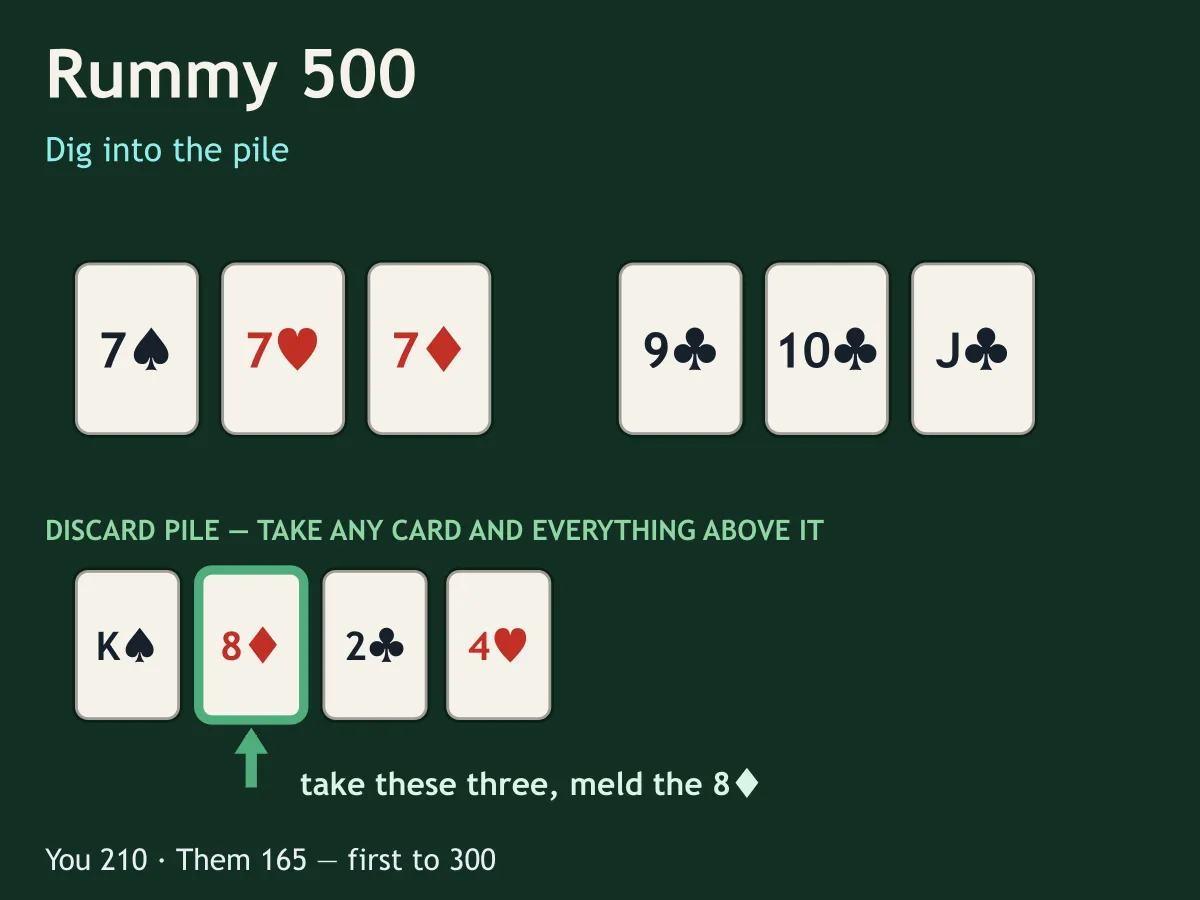
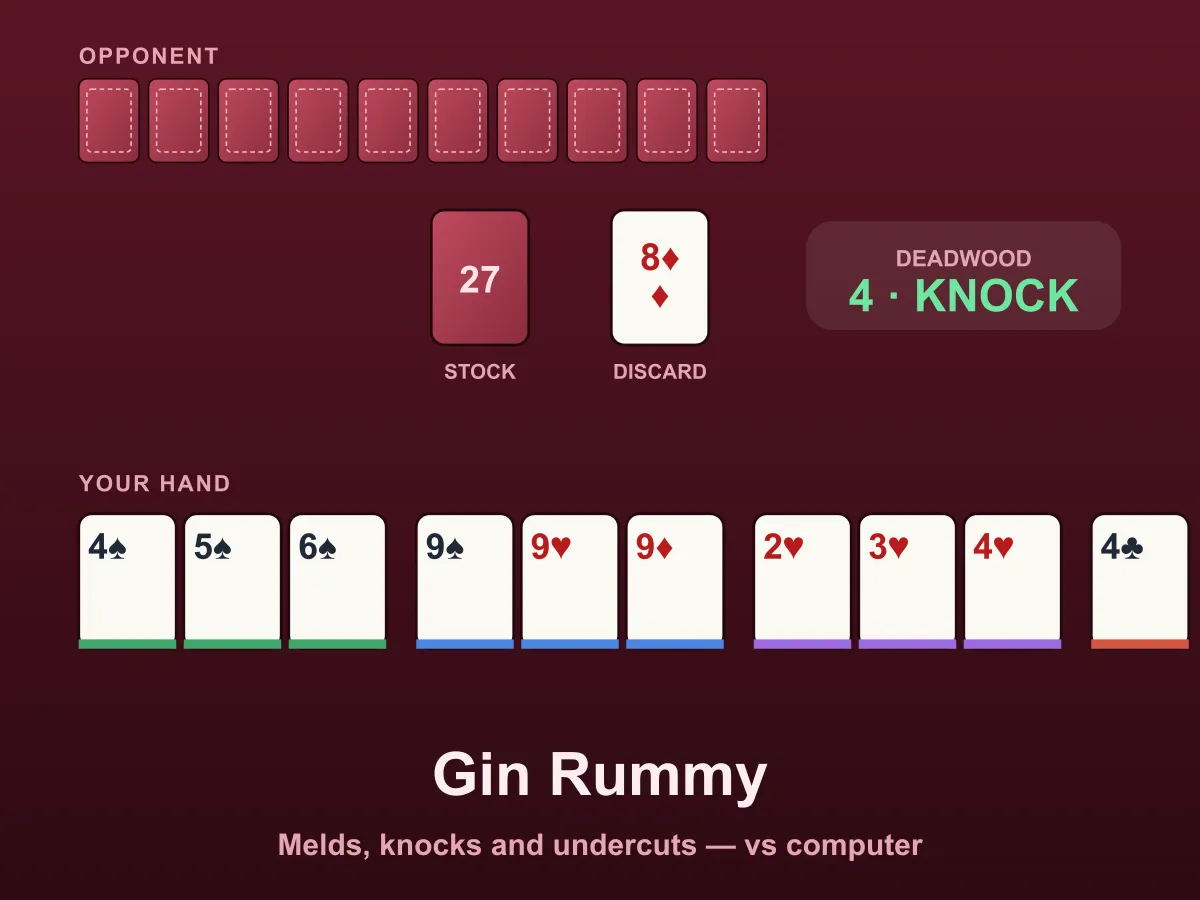
Rummy 500 lets you lay down any set or run the moment you hold it, and Gin Rummy is a two-handed game ended by a knock. In Shanghai Rummy you cannot put a single card on the table until you hold the whole contract for the deal, the contract changes every deal, and the buy lets you take discards out of turn. There are also three or four players instead of two, two packs with Jokers, and the lowest total wins.
How good are the computer players?
Relaxed players plan their contracts but never buy, and about one discard in three is careless while they are still building the contract. Sharp players plan every discard against the contract, take the upcard when it helps and buy the cards they need. In our test matches, both levels finished ahead of a random-move player almost every match, and a Sharp player finished with the lowest total in about three matches out of four against three Relaxed ones. The Hint button plays the way a Sharp player would. The computer never sees your cards or the stock.
How long does a game of Shanghai Rummy take?
Seven deals, and a deal usually lasts between five and fifteen turns each. A full game usually takes 15 to 30 minutes, depending on how quickly you play. Your total and your best (lowest) score for each table setting are kept in your browser.
Can I play Shanghai Rummy with the keyboard?
Yes. Tab moves through your cards and the buttons, and Space or Enter selects a card. S draws from the stock, U takes the upcard, G goes down, L lays off the selected card, X discards it, H shows a hint, Y and N answer a buy offer, and Escape clears your selection.