
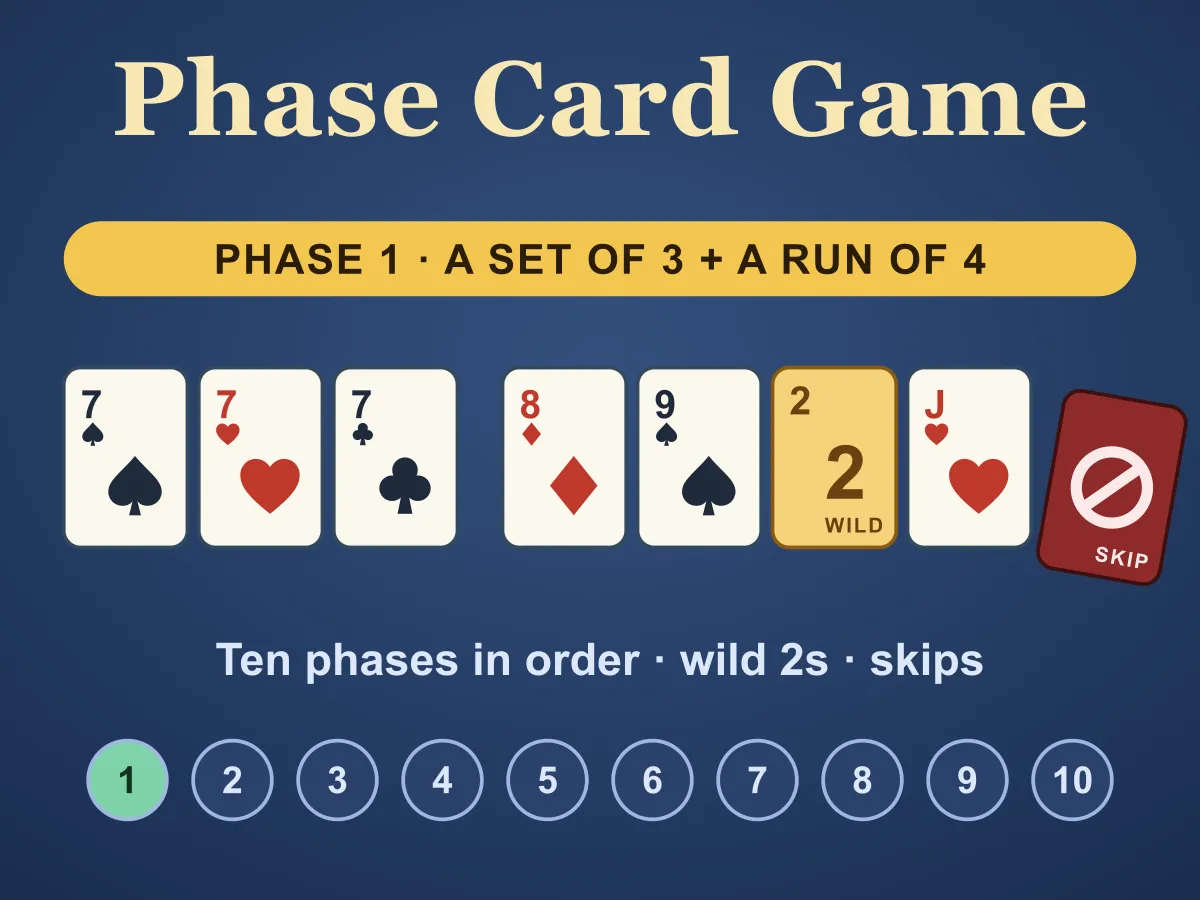



The phase card game is rummy with a to-do list. Each hand you draw and discard to collect your current phase — a set of 3 and a run of 4, then a run of 6, two sets of 3, and on through ten of them, each needing more draws than the last. Lay a phase down and you can add your spare cards to anyone's groups on the table; the first player out of cards ends the hand, everyone who laid down moves on while the rest stay put, and every player scores penalty points for the cards still in hand. It is played here with two ordinary packs: the 2s are wild, the four jokers are skips that make a player miss a turn, and the ace is high. Six tables take you from three phases against a beginner to all ten against three careful players who remember what you pick up. Free, in your browser, with no download.
How to play Phase Card Game
- Press Play and pick a table. Everyone is dealt ten cards from two packs; one card is turned face up to start the discard pile, and the bar above your hand shows your phase and how many cards you are short of it.
- On your turn, draw first: tap the stock (D) or take the face-up card (T). A skip can never be taken from the pile.
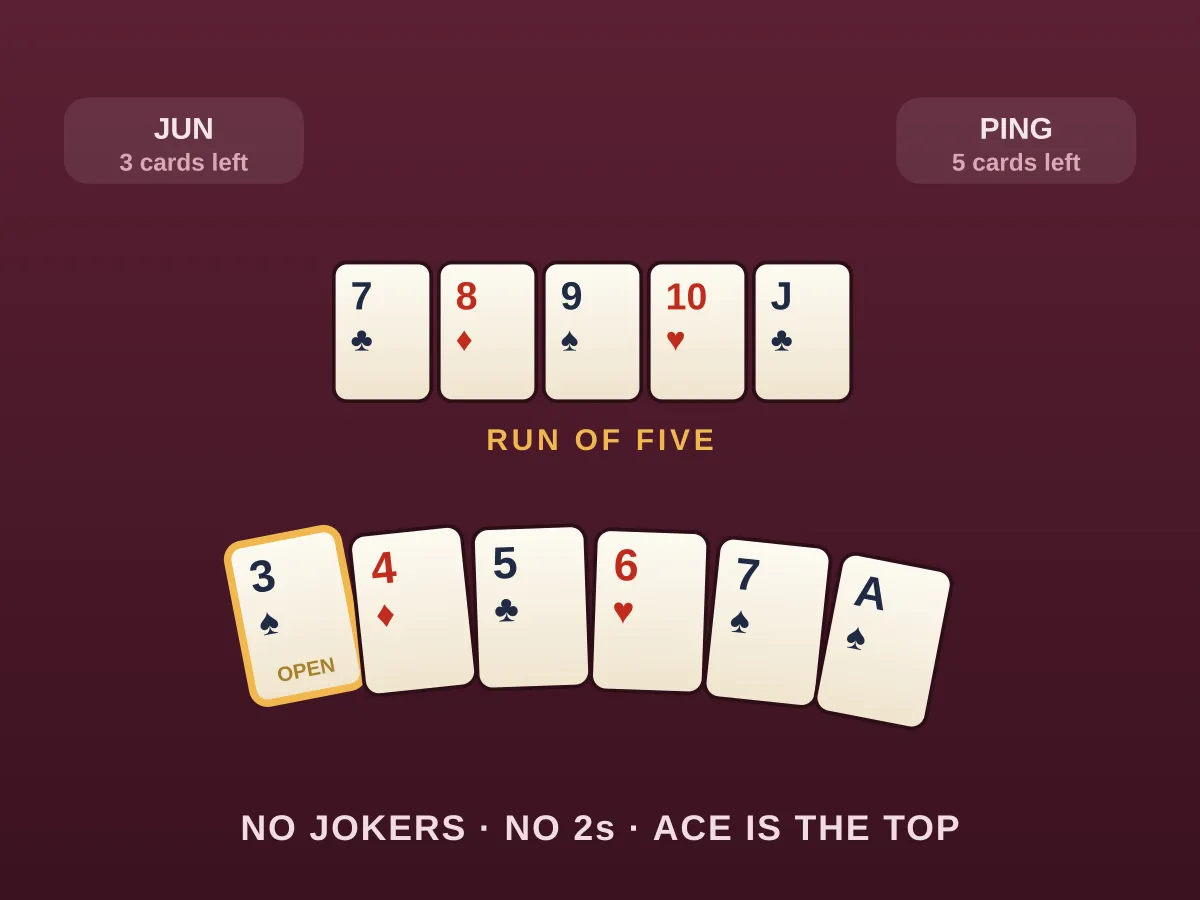
- Select the cards that make your phase — a set is cards of one rank, a run is ranks in a row from 3 up to ace in any suits, and a suit group is cards of one suit — and press Lay down (L). Every group needs at least one real card; wild 2s stand in for anything else.
- Once your phase is down, select a spare card and tap a lit group on the table to add it: the same rank on a set, the next rank at either end of a run, the same suit on a suit group, or a wild anywhere.
- End every turn by discarding one card (X). Discard a skip and you choose a player who misses their next turn.
- The first player with no cards left ends the hand. Everyone who laid down moves on to the next phase; everyone scores penalty points for the cards they still hold — 5 for a 3 to 9, 10 for a ten to an ace, 15 for a skip and 25 for a wild.
- Hands carry on until someone finishes the table's last phase. The lowest score among the players who did wins. Win for a star; finish with fewer points for two or three.
- Keyboard: 1 to 9, 0 and - pick cards, H shows a good move, S sorts by rank or suit, M jumps to the table, and the arrow keys move between cards.
Tips
- Runs are easier than sets: there are eight of every rank, and a run takes any suit, so a run of 6 is quicker to collect than two sets of 3. Keep the cards that are next to each other.
- Take the face-up card only when it brings you closer to your phase. Everyone sees what you take, and the careful players will stop throwing you that rank.
- Save your wilds for the gaps nothing else can fill, and lay down without them if you can — a wild left over is the easiest card to add to the table afterwards, and a wild caught in your hand costs 25 points.
- Once you are down, hold on to cards that fit the table and throw away the high ones that do not: tens to aces cost 10 points each if someone goes out first.
- Throw a skip away early. It is 15 points in your hand and fits no group, and a rival who has laid down is the one worth skipping.
- When a rival is down to two or three cards, the hand could end on their next turn — shed your most expensive cards, or skip them.
FAQ
Is the phase card game free to play?
Yes. It runs in your browser with no download, no sign-up and nothing to buy. All six tables are included and open one after another as you win them.
What are the ten phases?
1: a set of 3 and a run of 4. 2: a run of 6. 3: two sets of 3. 4: a run of 7. 5: a set of 3 and a run of 6. 6: seven cards of one suit. 7: two sets of 3 and a run of 4. 8: a run of 9. 9: three sets of 3. 10: two sets of 4. They are in order of difficulty, measured: a careful player collecting alone needs about three draws on average for the first phase and about twelve for the last, and every phase takes more than the one before.
Is this the same as Phase 10?
It is the same family of game — complete a list of phases in order, with wilds and skips — but it is not Phase 10, which is Mattel's trademarked card game, and this site has no connection with it. This version is played with two ordinary packs and four jokers, and its ten phases are its own, ordered by how many draws each one takes.
What counts as a set, a run and a suit group?
A set is cards of the same rank, in any suits. A run is ranks in a row — 3 up to ace, with the ace high only, so it never wraps round to a 3 — in any suits. A suit group is cards of one suit in any ranks. Each group needs at least one natural card, and wild 2s can fill the rest.
Can I lay down more cards than the phase asks for?
You lay down exactly your phase, then add more straight away: once your own phase is on the table you can add a card to any group, yours or anyone else's, on the same turn and every turn after. You can go out by adding your last card to the table.
What happens if I do not finish my phase before someone goes out?
You stay on the same phase for the next hand and score penalty points for every card you still hold. Everyone who did lay down moves on, so one missed hand can put you a phase behind.
How do skips work?
The four jokers are skips. Discard one and you pick a player to miss their next turn — with two players, that means you go again. A skip cannot be picked up from the pile, and if one is turned up to start the pile, the first player misses their turn.
How good is the computer?
There are three players. The beginner throws away cards at random. The club player keeps the cards closest to its phase, and beats the beginner on about nine hands in ten when both play the same deal from each seat. The card sharp also remembers what the next player picks up and avoids feeding them that card, and sheds its expensive cards when someone is about to go out: it beats the club player on about seven hands in ten where the two come out differently. Whole games carry more luck — the club player wins about four in five from the beginner, the card sharp only a little over half from the club player.
How hard are the tables?
Measured on deals the tables were not tuned on, a careful player wins the first table about three times in four and the Grand Final, against three card sharps, about one time in four — the same as any of the four players there. Every table is harder than the one before it, except that the Tournament comes out about level with the Café Corner. Throwing cards away at random wins the first table less than half the time, about one game in five at the second, about one in twelve at the third, and hardly ever after that.
How do the stars work, and can I leave a long game?
Win a table for one star; finish with a lower final score for two or three — the numbers are on the result card and come from a careful player's own winning scores. A game you leave is kept: come back and it deals the hand you were on again from the start.
Does it work on a phone?
Yes. Every move is a tap, and held upright the table gets a taller frame so your eleven cards stay big enough to read. It also plays with a keyboard.