


Home / Card / Calculation Solitaire
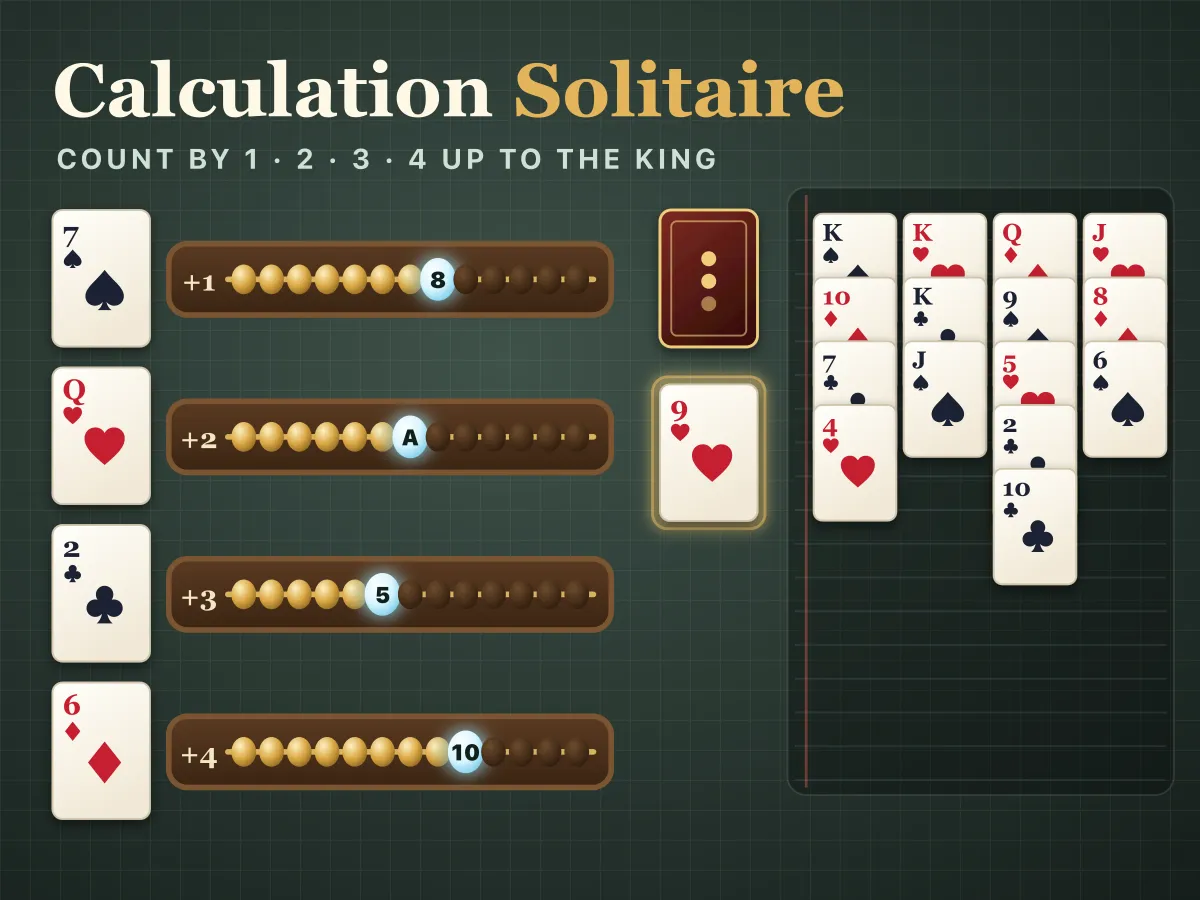
Calculation Solitaire, also called Broken Intervals, is the one-deck patience of counting, free to play online in your browser with no download and no sign-up. An Ace, a 2, a 3 and a 4 start four foundations, and each one counts up by its own step, ignoring suits and turning the corner after the King: A 2 3 4 … by ones, 2 4 6 8 10 Q A 3 … by twos, 3 6 9 Q 2 5 … by threes and 4 8 Q 3 7 J … by fours, until all four end on a King. The other 48 cards are turned from the stock one at a time, and each must be played straight away — onto a foundation it fits, or onto any of four waste piles, whose top cards can go home later but never move between piles. There is one pass and no redeal, so the whole game is where you put each card. It is a game of planning under uncertainty: knowing the order of the stock, our solver wins 2,016 of the first 2,400 deals, while a simple rule-of-thumb player that cannot see the stock wins only 173 of them. Watch an abacus beside each foundation count off the ranks and light the one it wants next, drag or tap to play, undo any move, ask for a hint, switch on the published holding-spot variation, and replay any deal by its number.
How to play Calculation Solitaire
- The game lays out an Ace, a 2, a 3 and a 4 as four foundations; suits do not matter. The other 48 cards are shuffled into a face-down stock, and its top card is turned for you.
- Each foundation counts up by its own step and turns the corner after the King. By ones: A 2 3 4 5 6 7 8 9 10 J Q K. By twos: 2 4 6 8 10 Q A 3 5 7 9 J K. By threes: 3 6 9 Q 2 5 8 J A 4 7 10 K. By fours: 4 8 Q 3 7 J 2 6 10 A 5 9 K. The abacus beside each foundation (the tag under it on a phone) lights the rank it wants next.
- Play the turned card before the next one turns: onto a foundation that wants its rank, or onto any of the four waste piles — any card can go on any pile. Tap the card to send it home, or tap a waste pile (or press 1–4) to lay it there; dragging works too.
- The top card of a waste pile may go to a foundation at any time — tap it when it glows, drag it, or tap the foundation to pull it in. Cards never move from one waste pile to another, so lay each one with care.
- There is one pass through the stock and no redeal. You win when all four foundations end on a King, all 52 cards home. If the stock is spent and nothing in reach fits, the count stops: undo, replay the deal, or start a new one.
- The Holding spot mode adds the published one-card holding spot: park the turned card there, turn the next, and play the held card later to a foundation or a waste pile.
Tips
- Build each waste pile backwards along a foundation: lay a card on the card that comes right after it in some count — a 10 on a King for the threes (… 7 10 K), a 7 on a 9 for the twos — and the pile will play off in order later.
- Never bury a card that a foundation will want soon. A card on a waste pile only goes home after everything laid on top of it, so put the late cards down first and the early ones on top.
- Kings come last on every foundation: give them a pile of their own, ideally an empty one at the bottom, and stack Kings on Kings.
- Sixes, eights and Queens are wanted early by several counts, and tens, Jacks and Kings late; keep the early ones near the top of your piles.
- Keep an empty waste pile while the stock is long — it is the only safe home for a card that would bury something wherever else it went — but spend it freely near the end.
- Stuck on a placement? Press Hint. It knows the order of the stock, so it shows a line that still wins whenever one can be found.
FAQ
Is Calculation Solitaire free to play?
Yes. Calculation Solitaire is completely free to play online in your browser, with no download, no account and no in-game purchases. It works on phones, tablets and computers.
How do you play Calculation Solitaire?
An Ace, a 2, a 3 and a 4 start four foundations that count up by ones, twos, threes and fours, ignoring suits and wrapping past the King, until each ends on a King. Turn the stock one card at a time and play each card at once, onto a foundation it fits or onto any of four waste piles. The top cards of the waste piles can go home later but never move between piles. You win with all 52 cards on the foundations.
What are the four counting sequences?
By ones: A 2 3 4 5 6 7 8 9 10 J Q K. By twos: 2 4 6 8 10 Q A 3 5 7 9 J K. By threes: 3 6 9 Q 2 5 8 J A 4 7 10 K. By fours: 4 8 Q 3 7 J 2 6 10 A 5 9 K. Count with Jack as 11, Queen as 12 and King as 13, and after 13 start again from 1. Every rank appears once in each sequence, and all four end on a King.
Why is it called Calculation?
Because you spend the game doing sums: each foundation adds its own step, so knowing that the twos want a 10 after the 8, or that the fours want a 3 after the Queen, is the whole skill. The game is also known as Broken Intervals, Hopscotch and Four Kings Solitaire.
How often can you win Calculation Solitaire?
It depends hugely on how you place the cards, which is what makes it a skill game. We measured the first 2,400 deals. Our solver, which knows the order of the stock, finds a win in 2,016 of them, about five deals in six; none of the rest was proved unwinnable — the search simply ran out of time on them. A rule-of-thumb player that cannot see the stock — it sends every card home that fits and lays the others where they hold up the fewest cards wanted sooner — wins only 173, about one deal in 14. The gap between those two numbers is the room for skill.
What is the Holding spot mode?
A published variation of Calculation adds a one-card holding spot. You may park the turned card there and turn the next one, then play the held card later to a foundation or a waste pile. It makes the game easier: with the holding spot the solver wins 2,164 of the same 2,400 deals, about nine in ten, and the rule-of-thumb player 269, about one in nine. Your wins and streaks are kept separately for each mode.
Can I move a card from one waste pile to another?
No. That is the heart of the game: once a card is on a waste pile it can only leave it by going to a foundation, and the cards under it wait until it does. Choosing the pile for each turned card is the decision that wins or loses the deal.
What do the abacus beads show?
Each foundation has a rod of thirteen beads, one per rank in the order that foundation counts. Beads already played turn gold, and the bead the foundation wants next is lit up, so you never have to work out the next rank in your head. On a phone the rods become a tag under each foundation showing the next rank and how far the count has got. Any card in reach that fits a foundation right now glows gold.
How does the hint work?
The hint asks the solver, which knows the order of the stock — something you cannot see — so it is a peek at a winning line rather than a rule of thumb. While it can find a winning line from your position it shows that line's next move and says so; tapping the hinted card plays it. If it finds none in time, it shows what the rule-of-thumb player would do.
Can I undo a move, and what is the deal number?
Yes, every move can be undone one at a time, right back to the deal, even after the game has ended. Every game has a number from 1 to 999,999 shown at the top of the table; the same number always deals the same cards, so Replay deal gives you the same game again and New deal picks a different one.
Does it save my game, and can I play with a keyboard?
An unfinished deal is saved in your browser and picks up where you left it. With a keyboard, 1 to 4 lay the turned card on waste pile 1 to 4 and 5 parks it in the holding spot; the arrow keys move between piles and Enter acts like a tap; U undoes, H asks for a hint and N starts a new deal.