


Scopa is a free online version of the Italian card game of captures, one-on-one against the computer at four tables. It uses the 40-card Italian deck of coins, cups, swords and batons — drawn here with its own suit pictures, or switched to French suits with one button — and every card counts as its number: ace 1, two to seven as printed, then the fante 8, the cavallo 9 and the re 10. Each hand deals three cards to each player and four face up on the table. On your turn you play one card: it takes a table card of the same value, or a group of table cards that add up to it, and if it can take nothing it stays on the table. Two rules make it Scopa. A card that can capture must capture, and if a single table card matches it, it must take that card rather than a sum. Clearing the table is a scopa, worth a point on the spot — except with the last card of the hand. When the hands run out three more each are dealt, and when the stock is gone, whatever is left on the table goes to whoever captured last. Then the hand is counted: a point each for most cards, most coins, the seven of coins (the settebello) and the best primiera, plus one for every scopa. The first to 11 wins; the last table plays to 21. The opponents get stronger table by table: one who plays whatever comes to hand, a club regular who grabs the settebello and avoids leaving an easy sweep, and a card counter who works out from the cards already played what you could be holding.
How to play Scopa
- Press Play and pick a table. The first is against a beginner; each table you win opens the next.
- You and the computer get three cards each, and four more go face up on the table. The player who did not deal plays first.
- On your turn, play one card by tapping it or pressing 1, 2 or 3. Every card counts as its number: ace 1, two to seven as printed, fante 8, cavallo 9, re 10.
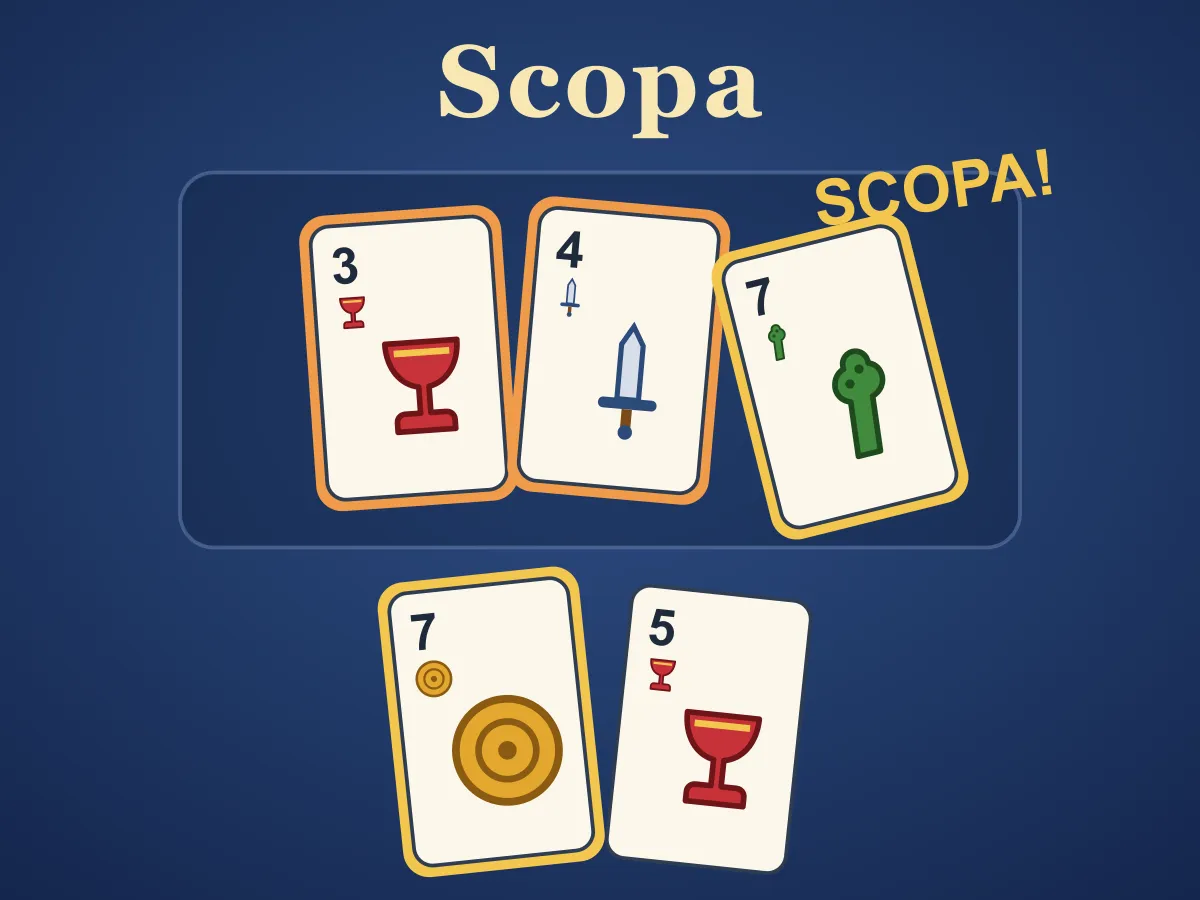
- Your card takes a table card of the same value, or a group of table cards that add up to it — a seven takes a seven, or a three and a four, or an ace, two and four. You keep the card you played and everything it took.
- If your card can capture, it must. If a single table card matches it, it must take that one card rather than a sum. If it can take nothing, it stays on the table.
- When a card could take cards more than one way, the game asks which: pick a button, press its number, or tap one of the lit table cards. Escape goes back to choose another card.
- Taking every card on the table is a scopa: a point on the spot, shown as a badge. The very last card of a hand never counts as a scopa.
- When both hands are empty, three more cards each are dealt from the stock. When the stock is gone, whatever is left on the table goes to whoever made the last capture.
- Then the hand is counted: a point for most cards (21 or more), most coins (6 or more), the seven of coins, and the best primiera, plus a point for every scopa. Level cards or coins score for nobody.
- The first to 11 points wins; the fourth table plays to 21. Level scores at or past the target play another hand. Win for one star, and win by the table's margins for two and three.
- The Italian cards / French cards button switches the faces between coins, cups, swords and batons and the French diamonds, hearts, spades and clubs. The game is the same.
Tips
- The seven of coins is a point by itself, and every seven is worth the most to a primiera. Take sevens whenever you can, and never leave the settebello on the table for a seven to pick up.
- Before you lay a card down, add up the table. A total of ten or less can be swept by one card of that value — lay down something that pushes it past ten, or leaves a card that no single card can clear.
- Count the cards. Once all four sevens are gone, a table adding up to seven is safe; once a card of some value is gone for good, nobody can take with it.
- Taking with a sum rather than a single card clears more of the table, which is how most scopas are set up — two or three small cards are often worth more than one big one.
- Coins are worth more than other suits: six of the ten win a point. When two captures are otherwise equal, take the one with a coin in it.
- Remember the leftover rule. In the last round, the last player to capture sweeps up whatever is left on the table, so it can pay to save a capture for your final card.
- The primiera goes to the side with the best card of each suit: seven 21, six 18, ace 16, five 15, down to 10 for the court cards. A side missing a whole suit has no primiera at all.
- In the last round the stock is empty, so the cards you have not seen are exactly your opponent's hand. Work out what they can take before you lay anything down.
FAQ
Is Scopa free to play online?
Yes. It runs in your browser for free, with no download, no install and no account. Nothing is wagered and nothing pays out.
What is a scopa?
Taking every card on the table with one card. It is worth a point straight away, and it is where the game gets its name — scopa means broom. A capture with the very last card of a hand does not count as one.
Do you have to capture in Scopa?
Yes. A card that can take something must, and if a single table card matches its value it must take that card rather than a group that adds up to it. You are still free to choose which card from your hand to play — only a card that can take nothing is laid on the table.
How is a hand of Scopa scored?
A point each for most cards (more than 20 of the 40), most coins (more than 5 of the 10), the seven of coins — the settebello — and the best primiera, plus a point for every scopa. A tie in cards or coins scores for nobody.
What is the primiera?
Each side's best card in each of the four suits, valued seven 21, six 18, ace 16, five 15, four 14, three 13, two 12 and the court cards 10, added up. The higher total takes the point. A side with no card at all in some suit has no primiera, and loses the point to a side that has all four.
What happens to the cards left on the table at the end?
When the stock is gone and both hands are played out, whatever is still on the table goes to the last player who made a capture. It does not count as a scopa.
How good are the computer players?
There are three. The beginner plays whatever comes to hand. The club player grabs the settebello and sevens and avoids leaving a table that one card could sweep; dealt the same cards both ways round, it wins about three hands in four from the beginner. The card counter works out from the cards already played what you could be holding, and plays the last round perfectly; on the same cards it wins about six hands in ten from the club player, and the club player takes only about a third of its games off it.
How is Scopa different from Briscola?
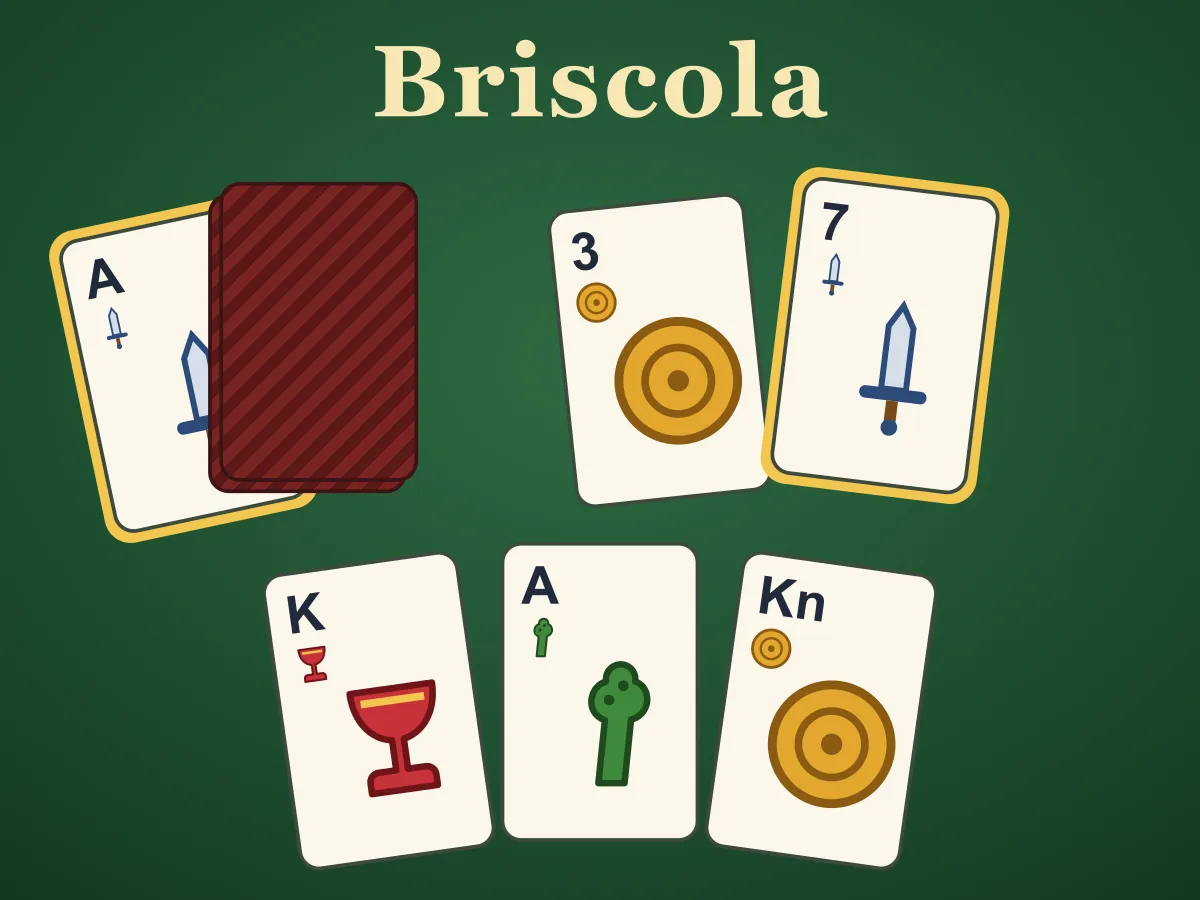
Both use the 40-card Italian deck, but Briscola is a trick-taking game with a trump suit, where cards score by rank. Scopa has no tricks and no trumps: you capture from the table by matching values and adding them up, and score for cards, coins, the settebello, the primiera and sweeps. Briscola is also on this site.
Can I play Scopa with French cards?
Yes. The Italian cards / French cards button switches between coins, cups, swords and batons and the French diamonds, hearts, spades and clubs, with J, Q and K as the 8, 9 and 10. The values and the rules do not change.
Does Scopa work on a phone?
Yes. Tap a card to play it, and tap a lit table card or a button when there is a choice of captures. On a keyboard, press 1, 2 or 3 to play and a number to choose.