


Home / Card / Grandfather's Clock Solitaire
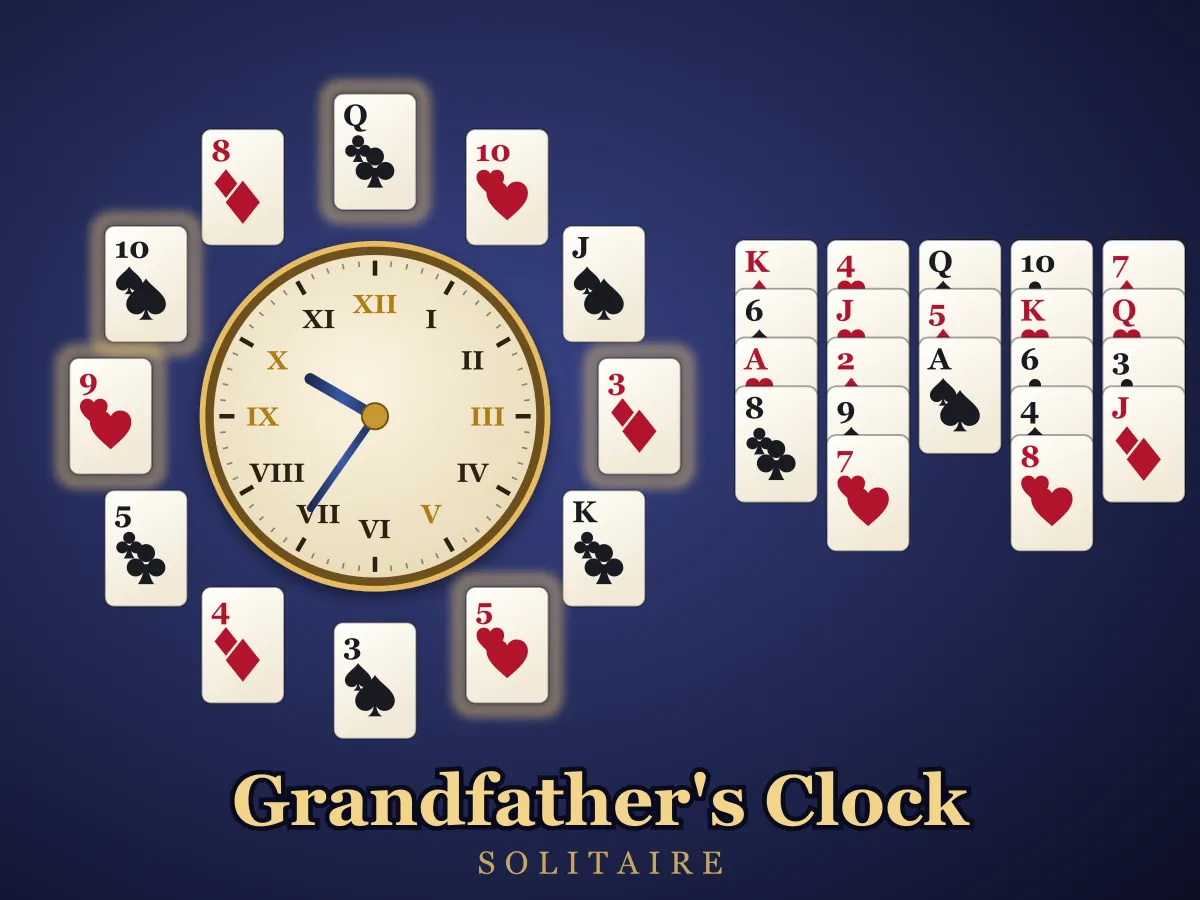
Grandfather's Clock Solitaire is the classic one-deck patience laid out as a clock face, free to play online in your browser with no download and no sign-up. Twelve cards start round the dial, one at each hour — 9♣ at noon, 10♥ at one, J♠ at two and on round to 8♦ at eleven — and the other 40 are dealt face up into eight columns of five. Each pile on the clock builds up in its own suit, turning the corner from King to Ace, until its top card shows its hour: a Jack at eleven, a Queen at noon, an Ace at one. In the columns only the top card moves, one at a time, building down regardless of suit — any 6 on any 7 — and an empty column takes any card. There is no stock and no redeal, and every card is in view, so it is all planning: our solver wins 2,374 of the first 2,400 deals and proves the other 26 cannot be won, and a simple rule-of-thumb player wins 1,837 of them. Watch the hands turn as the hours fill, drag single cards or whole runs, tap to play, undo any move, ask for a hint, and replay any deal by its number. Not to be confused with Clock patience, the luck game dealt in thirteen piles.
How to play Grandfather's Clock Solitaire
- The game sets twelve cards round a clock face, one at each hour: 9♣ at noon, 10♥ at one, J♠ at two, Q♦ at three, K♣ at four, then 2♥, 3♠, 4♦, 5♣, 6♥, 7♠ and 8♦ from five o'clock round to eleven. The other 40 cards are shuffled and dealt face up into eight columns of five.
- Each pile on the clock builds up in its own suit, one rank at a time, and turns the corner from King to Ace. It is finished when its top card shows its hour — Jack for 11, Queen for 12, Ace for 1 — so the piles at one to four o'clock take four more cards and the rest take three. Every card has exactly one place on the clock.
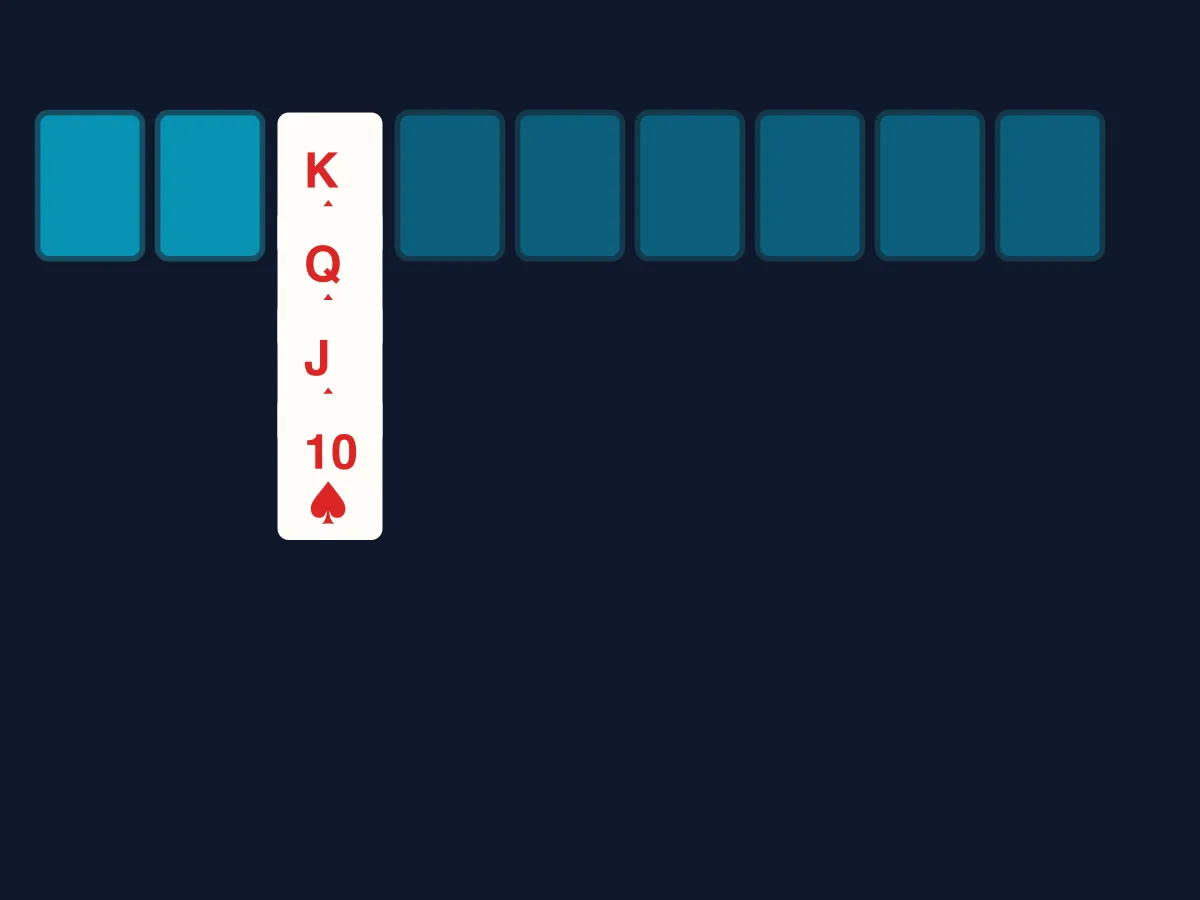
- Only the top card of each column is in play, and cards move one at a time. Move a top card onto another column when it is exactly one rank lower, in any suit: any 6 on any 7. Nothing goes on an Ace in the columns. Drag a card, or tap it to send it home, onto a column one rank higher, or into an empty column.
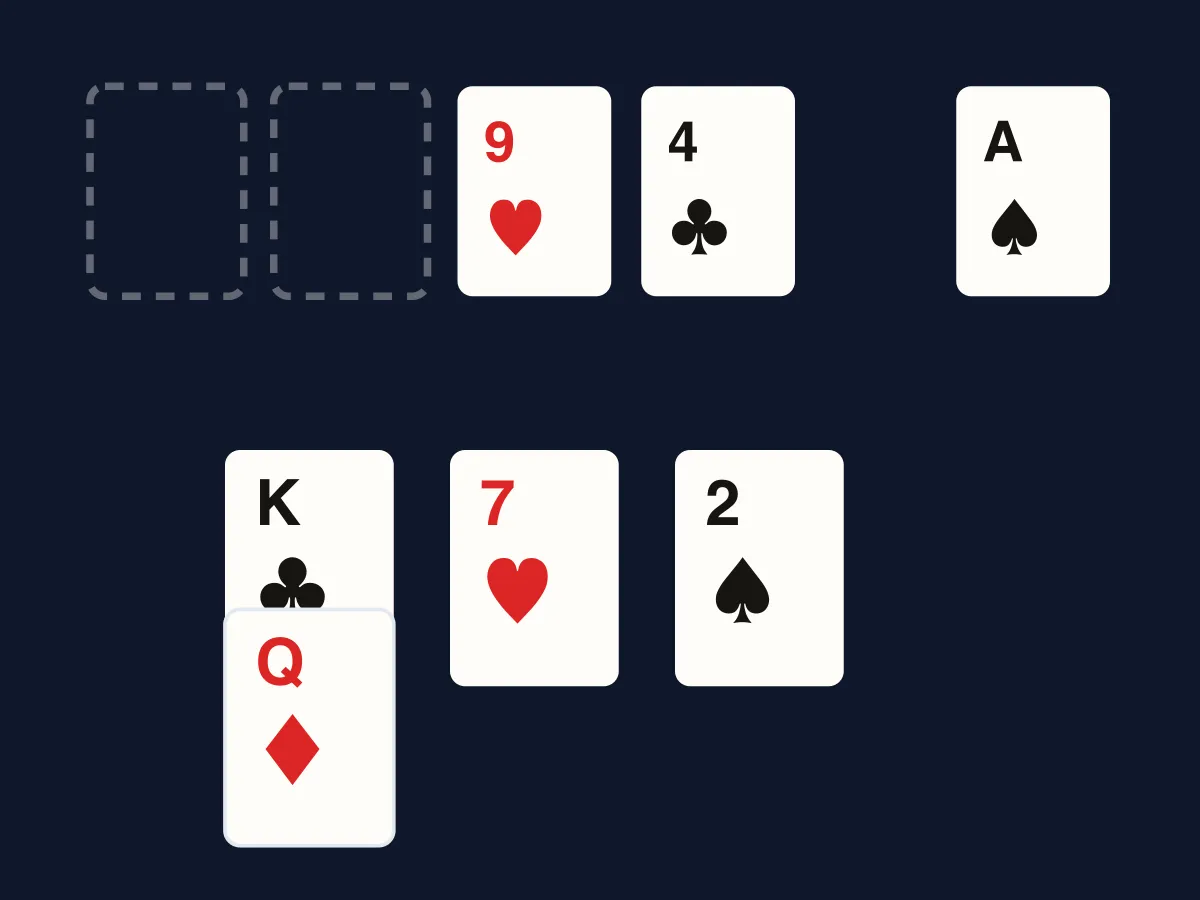
- An empty column takes any card. A run that builds down can be dragged as one when there are enough empty columns to move it one card at a time: two cards need one empty column, four cards need two. The game makes the single moves for you and counts each one.
- The game sends a card home by itself when nothing could still need it in a column: any Ace, and any card once all four cards one rank lower are on the clock. Everything else you send yourself.
- You win when every hour shows its time and all 52 cards are on the clock. There is no stock and no redeal; if no sequence of moves can bring another card home, the clock stops: undo, replay the deal, or start a new one.
Tips
- Every card is face up, so read the whole table first. For each hour, find the next card it needs and count what lies on top of it — the most buried ones are where the game is decided.
- Empty a column early. With any card allowed into it, one empty column lets you dig out a buried card or move a run of two, and two empty columns move a run of four.
- Building down ignores suit, so you usually have a choice of where a card can go. Prefer a column whose cards already run downwards, where it buries nothing you still need to reach.
- Do not rush a card home if a lower card still needs it as a place to sit. The game only sends cards home by itself when that can never hurt; everything else is your call.
- Press Hint whenever you are unsure. While a winning line exists it shows its next step and says so, and once a deal can no longer be won it tells you, so you know to undo rather than play on.
FAQ
Is Grandfather's Clock Solitaire free to play?
Yes. Grandfather's Clock Solitaire is completely free to play online in your browser, with no download, no account and no in-game purchases. It works on phones, tablets and computers.
How do you play Grandfather's Clock Solitaire?
Twelve cards are set round a clock face, one per hour, and the other 40 are dealt face up into eight columns of five. Build each pile on the clock up in its own suit, turning the corner from King to Ace, until its top card shows its hour. In the columns, move one top card at a time onto a card one rank higher in any suit, and use empty columns for any card. You win when all twelve hours show their time.
Which card starts at each hour?
9♣ at noon, 10♥ at one, J♠ at two, Q♦ at three, K♣ at four, 2♥ at five, 3♠ at six, 4♦ at seven, 5♣ at eight, 6♥ at nine, 7♠ at ten and 8♦ at eleven. The suits go round hearts, spades, diamonds, clubs, and each card is three or four ranks below the hour it has to reach.
Why do some hours take more cards than others?
Each pile stops when its top card matches its hour. The 2♥ at five o'clock needs the 3, 4 and 5 of hearts — three cards. The 10♥ at one o'clock has to climb J, Q, K and then turn the corner to the Ace, which counts as one — four cards. The same happens at two, three and four o'clock, so those four hours take four cards each and the other eight take three, 40 cards in all.
How often can you win Grandfather's Clock Solitaire?
Very often — it is one of the friendlier patiences. We measured it on the first 2,400 deals. With every card in view, our solver wins 2,374 of them, about 99 in every 100, and proves that the other 26 cannot be won whatever you do — about one deal in 92. A rule-of-thumb player that sends cards home and otherwise makes the move that looks best one step ahead wins 1,837, about three deals in four. Thinking a few moves ahead makes up the difference.
Is this the same game as Clock Solitaire?
No. Clock patience, also called Clock Solitaire, deals the whole deck into thirteen face-down piles and plays itself out by luck, with no decisions to make. Grandfather's Clock uses the clock face only for its foundations: you play from eight open columns and every move is your choice. You can play both here.
Can I move more than one card at a time?
The rules move one card at a time, but this version lets you drag a run that builds down as one move whenever there are enough empty columns to make the same move card by card: two cards need one empty column, four cards need two, eight need three. The game plays the single moves for you and counts each one, so nothing about the game changes.
Can a King go on an Ace in the columns?
Not here. We follow the rules as BVS Solitaire and PySol publish them, where the columns build down from King to Ace and stop there; only the clock turns the corner from King to Ace. Some versions, such as Semicolon's, let a King go on an Ace in a column too, which makes the game a little easier.
What do the clock hands show?
They are there to watch, not to play. The hour hand turns to the last hour you played a card to, and the minute hand goes once round the dial as the 40 dealt cards come home. When you win, both hands meet at twelve. Each hour that already shows its time lights up in gold, numeral and all.
How does the hint work?
The hint asks the same solver. While it can find a winning line from your position, it shows that line's next step and says so; tapping the hinted card plays it. If every position reachable from yours has been searched without a win, the hint tells you the deal can no longer be won, so you know to undo. If you lose, the result card also says whether the deal itself could ever have been won.
Can I undo a move, and what is the deal number?
Yes, every move can be undone one at a time, right back to the deal, even after the game has ended. Every game has a number from 1 to 999,999 shown at the top of the table; the same number always deals the same cards, so Replay deal gives you the same game again and New deal picks a different one.
Does it save my game, and can I play with a keyboard?
An unfinished deal is saved in your browser and picks up where you left it. With a keyboard, the arrow keys move between piles, Enter plays the top card, U undoes, H asks for a hint and N starts a new deal.