
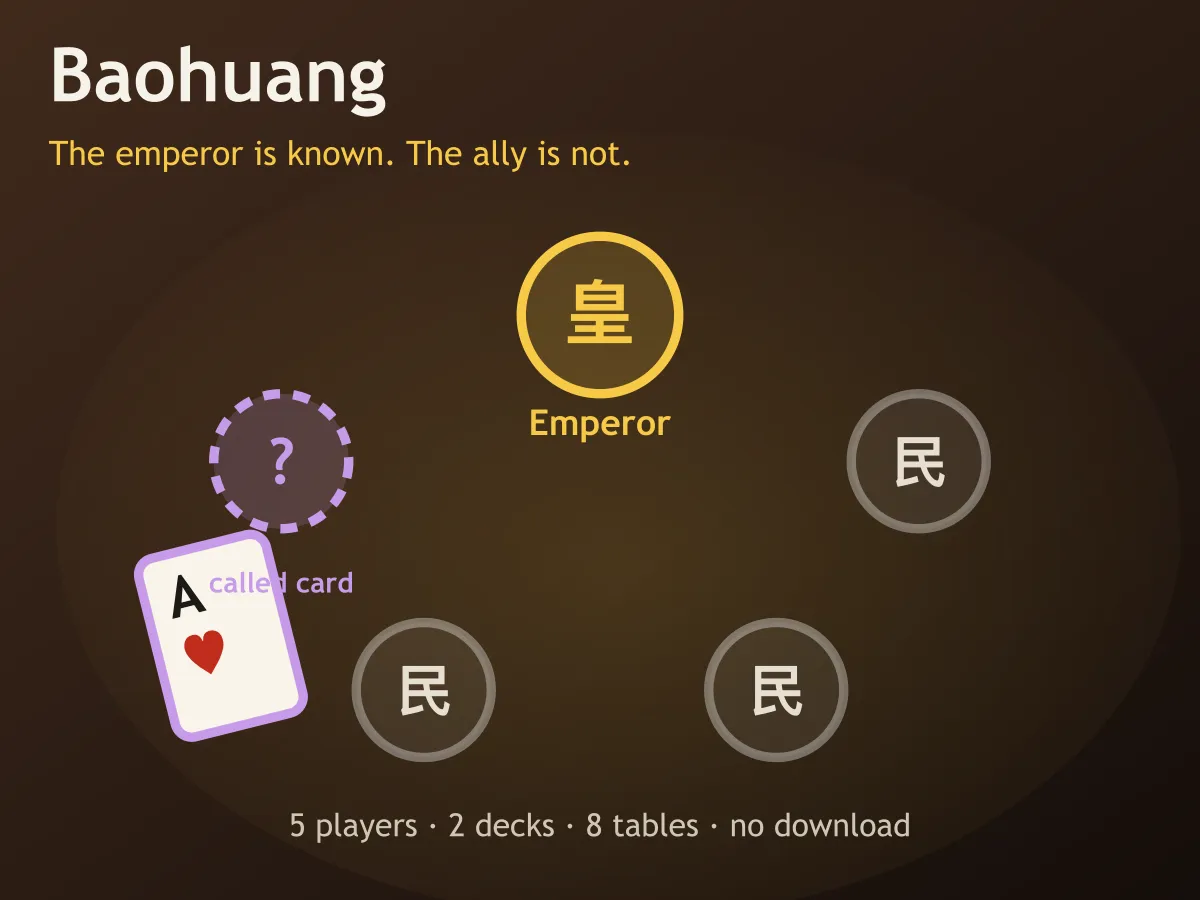





Baohuang is a free online Chinese card game for five players — you against four computer opponents — built around one thing the other shedding games here do not have: hidden teams. Two decks are dealt out, twenty-one cards each. One seat is the Emperor, which everyone can see, and the Emperor calls for a card. Whoever holds that card is secretly their Guard, and nobody else knows who it is. The two of them win by both emptying their hands before the three commoners can empty all of theirs. Until the called card is actually played, the whole table is guesswork: a pass that only makes sense if the passer wants the leader to survive is the tell, and the Guard is trying not to give one. Some deals you are the Emperor, some the Guard, some a commoner working it out — three genuinely different games from one set of rules. Eight tables, no download, no account, no real money.
How to play Baohuang
- Two decks are dealt out, twenty-one cards to each of the five seats. The three left over go to the Emperor.
- One seat is the Emperor and everyone can see who. The Emperor calls for a card they are not holding, and whoever holds it is their Guard.
- You are told your own role at the top of the screen. If you hold the called card, it is outlined in your hand — playing it is the moment you announce yourself.
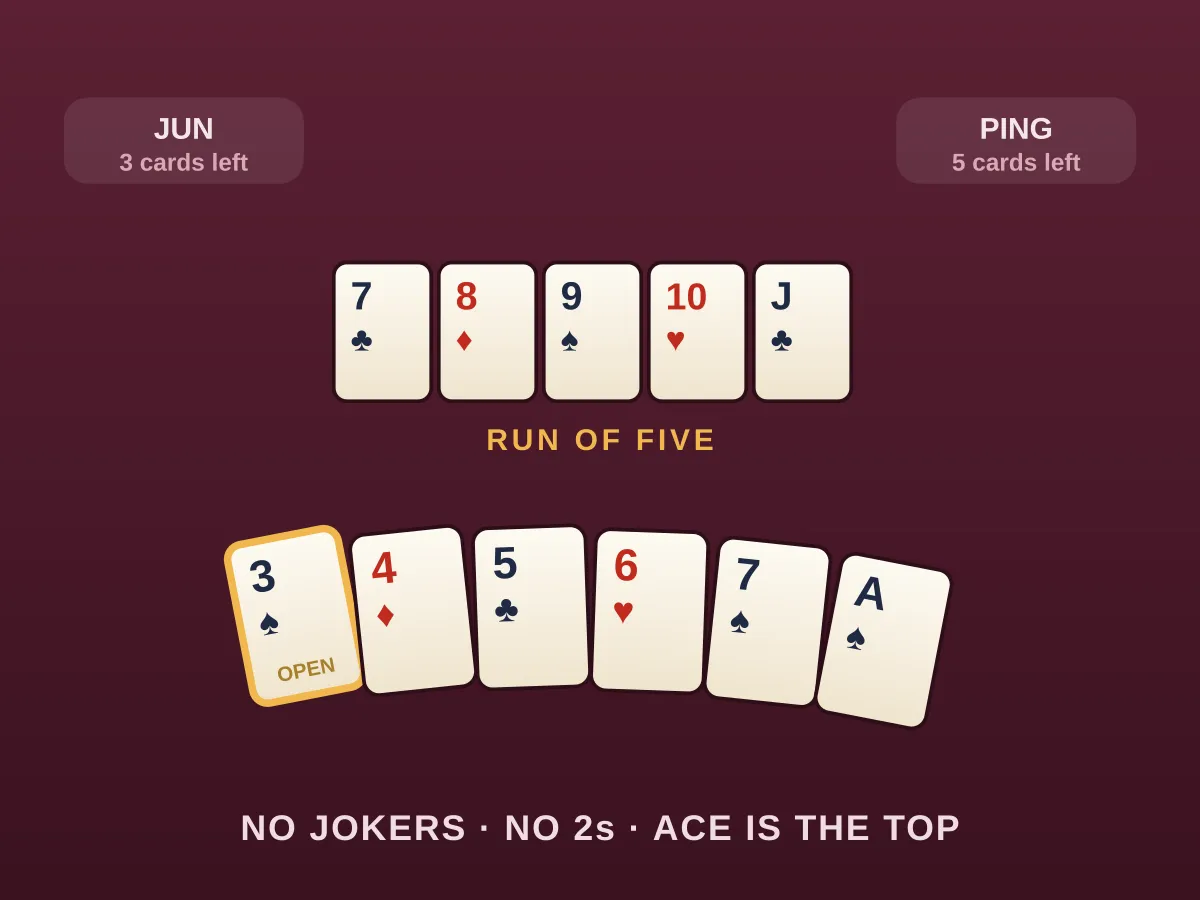
- Play climbs: beat the table with a bigger play of the same shape and size — a single, a pair, a triple, a triple with a pair, a straight of five or more, or a run of three or more pairs.
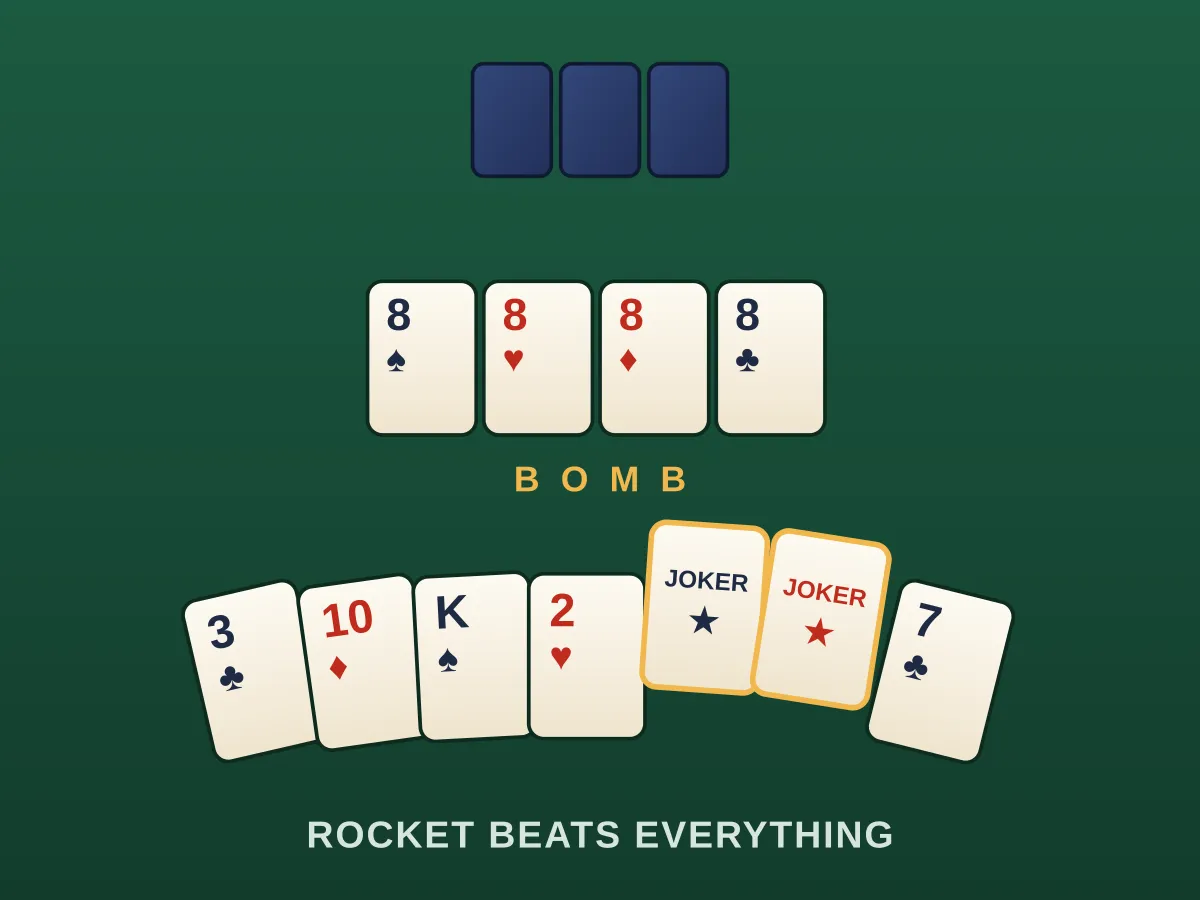
- Four or more of a rank is a bomb and interrupts any shape. A longer bomb beats a shorter one whatever the ranks, and the two jokers together are a rocket that nothing beats.
- Twos and jokers never appear inside a straight or a run of pairs.
- Pass if you cannot or will not beat the table. When everyone still holding cards has passed, the last player to put cards down leads again for free.
- The Emperor and Guard win the deal if both of them empty their hands before all three commoners empty theirs.
- Points go to the winning side, and more of them for finishing early — so the Guard still races rather than coasting. Bank the level target to move up.
Tips
- Watch for passes that make no sense. A seat that could clearly have taken the lead and let the Emperor keep it is either weak or the Guard, and doing it twice usually means the second one.
- If you are the Guard, spend the called card at a moment when it does not matter. Playing it into a trick you were going to win anyway tells the table far less than dropping it under pressure.
- If you are the Emperor, do not cover your Guard too early. Every time you take the lead off a commoner to protect them, you narrow the guess for everyone.
- As a commoner, take the lead off the Emperor whenever it is cheap. You have three players to their two, so trades that cost everyone a little are trades you win.
- Bombs are worth more here than in a three-player game, because there are two decks: five of a rank is possible, and it beats four of anything.
- Do not break a run of pairs to answer a single. With twenty-one cards you will not get another chance to play six cards at once.
- When you are the Guard and the Emperor is nearly out, stop protecting and start shedding. The side needs both hands empty, and yours is the one that is behind.
- Count who has gone out, not just how many cards people hold. Once the third commoner is out the deal is over, so a commoner about to finish is more urgent than one holding two cards.
FAQ
Is Baohuang free to play?
Yes. It runs in the browser with no download, no sign-up and nothing to buy. All eight tables are included and unlock as you clear them. There is no real money and no wagering anywhere in the game.
How is this different from Fight the Landlord?
In Fight the Landlord the landlord is announced, so everyone plays knowing exactly who the one is and who the two are from the first card. Here the Emperor is public but their ally is not, and it stays hidden until the called card gets played. That changes what you are doing on every turn: you are reading the table as well as playing your hand.
How do I know which side I am on?
The banner above the table always tells you your own role. If you hold the called card you are the Guard and that card is outlined in your hand. If you are a commoner you know the Emperor but have to work out the Guard for yourself.
When does the hidden ally become public?
The moment the called card is played. In practice that happens in almost every deal and usually about a third of the way through, so the hidden phase is the opening rather than the whole game.
How does the Emperor's side win?
Both of them have to empty their hands before all three commoners empty theirs. Being first out on your own is not enough — the Emperor going out first and the Guard finishing last is a loss.
Can the Emperor call a card they are holding?
No. The call always goes to a card the Emperor does not hold, because calling your own card would make you your own ally and turn the deal into one player against four.
Do the computer players cheat?
No. Each seat sees only its own hand plus what has been played, exactly like you. The Emperor and the Guard know each other because they are told at the deal, which is the rule; the commoners have to infer it. What changes between tables is how well the opponents play and, from the fourth table up, whether they reason about who is allied with whom at all.
Does it work on a phone?
Yes. Twenty-one cards is a big hand, so on a narrow screen the hand row scrolls instead of pushing the table off the top, and cards are tapped to select before you press Play.