
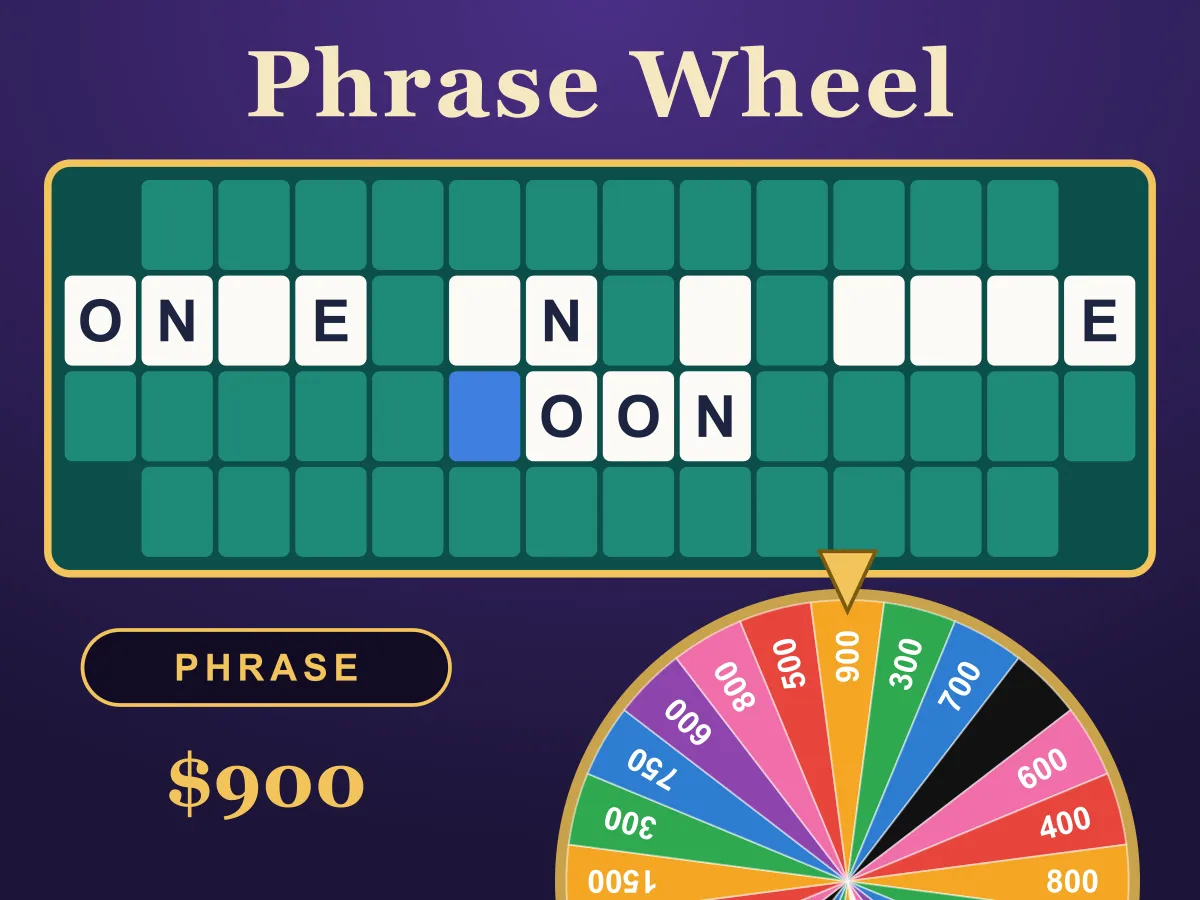




Phrase Wheel is a free word puzzle game show in your browser. Spin a 24-wedge prize wheel, call a consonant and earn the wedge’s value for every copy on the board, buy vowels for $250, and solve the hidden phrase to bank your money — but watch out for Bankrupt and Lose a Turn. Three rounds a show against two computer contestants, then a bonus round with R S T L N E given if you win. 382 hand-written puzzles in nine categories, seven shows from Morning Show to Champions Night. No download, and it works on phones.
How to play Phrase Wheel
- A hidden phrase sits on the board with its category underneath. You and two computer contestants take turns, and you go first in round one.
- On your turn press Spin. If the wheel lands on a cash wedge, call a consonant: every copy of it on the board turns over and pays you the wedge’s value. A consonant that is not there, a Bankrupt (your money for the round is gone) or a Lose a Turn hands the turn to the next contestant.
- Once you have $250 you can buy a vowel instead of spinning. A vowel costs the same whether it is in the phrase or not, and a vowel that is not there ends your turn.
- Press Solve whenever you think you know the answer, fill in the blanks with your keyboard or the letter buttons, and submit. A right answer banks your money for the round — at least $1,000 — and a wrong one passes the turn.
- Three rounds make a show, and the contestant with the most money wins it. Win the show and you play the bonus round: R S T L N E are given, you pick three more consonants and one vowel, and you get three tries to fill in the rest for a prize of $5,000 to $25,000.
Tips
- E and A are each in about three of every four puzzles here, and R, T and N in about three of five; Q, X, Z and J are each in a dozen puzzles or fewer out of 382. Call the common letters first.
- When you already know the answer, it can pay to keep spinning for money before you solve. In 3,000 test shows a sharp player who spun on until about $2,500 won 1,077, against 909 for one who solved straight away — Bankrupt is only 2 wedges of 24.
- Read the category. Every "What Are You Doing" answer has a word ending in -ING, so I, N and G are safe calls there, and about one "Place" answer in five starts with THE.
- In the bonus round R S T L N E already fill about two letters in five of the answer. Of the letters you choose, A is in nearly three bonus answers in four, and C, P, G and H are the most common consonants left — C in more than a third.
- Watch which consonants are left. When the last one in the phrase is called, the game tells you there are no more — after that only vowels and the solve remain.
FAQ
Is Phrase Wheel free to play?
Yes. Phrase Wheel is completely free to play in your browser, with no download, no account and no in-game purchases. The money on the wheel is play money for keeping score.
Does Phrase Wheel work on mobile?
Yes. On a phone you tap Spin and the letter buttons, and to solve you tap the letters into the blanks one by one. It plays held upright or sideways. On a computer you can play from the keyboard: Space spins, a letter key calls that letter, Enter starts or submits a solve, Backspace deletes and Escape cancels.
How does the wheel work?
The wheel has 24 wedges: 21 cash values from $300 to one $1,500 wedge, two Bankrupts and one Lose a Turn. A cash wedge pays its value for every copy of the consonant you call. Bankrupt takes away the money you have won this round (not your total from earlier rounds) and ends your turn; Lose a Turn just ends it.
What happens when you solve a puzzle?
You bank the money you won in that round, and a solved puzzle is always worth at least $1,000 even if you had less. The other two contestants keep nothing from that round. The totals after three rounds decide the show; if two contestants are level, the one who solved more puzzles wins, and if that is level too the show is a dead heat.
How does the bonus round work?
If you win the show you play one short puzzle on your own. R, S, T, L, N and E are filled in for you, then you choose three more consonants and one vowel, which are revealed too. You get three tries to fill in the rest of the answer. Solve it and a prize of $5,000, $7,500, $10,000, $15,000 or $25,000 is added to your score.
How is this different from Hangman?
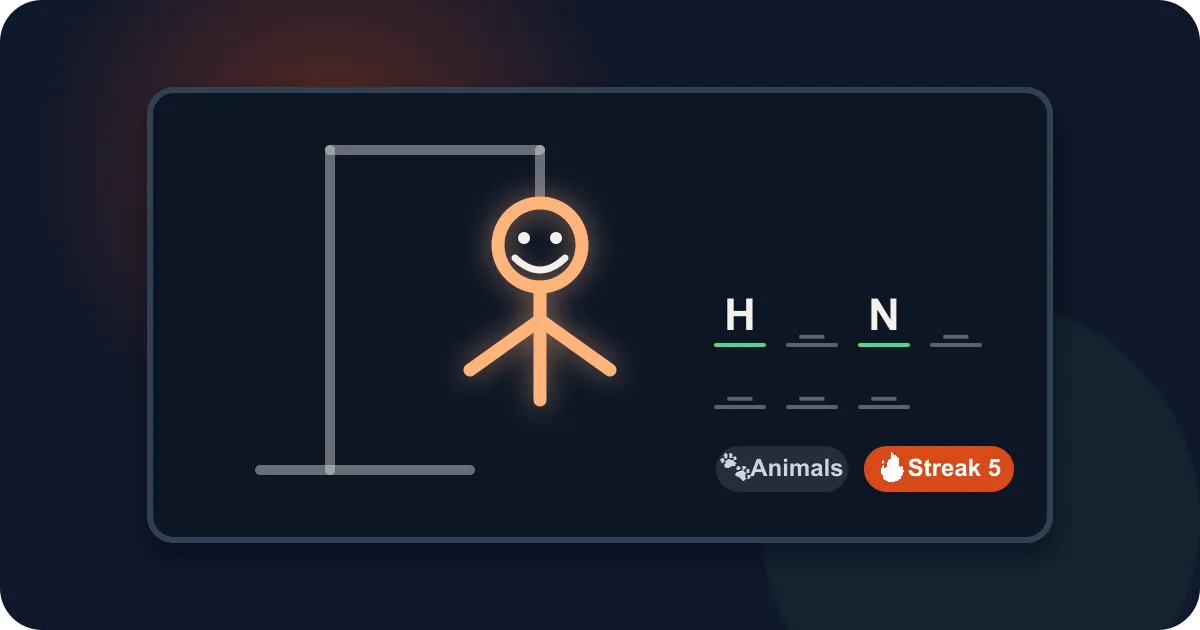
In Hangman you guess letters alone against a limited number of mistakes. In Phrase Wheel you play against two contestants for money: the wheel sets what each consonant is worth, vowels must be bought, a wrong letter passes the turn instead of drawing a figure, and the first contestant to solve the whole phrase banks the round. Hangman is on this site too if you want the classic.
How strong are the computer contestants?
There are four kinds: rookie, regular, sharp and champion. They differ in how much of the board they need to see before they read the answer, how well they choose letters and how often they misread. Each beats two of the kind below it most of the time: over 900 three-player shows, a regular beat two rookies 491 times, a sharp beat two regulars 512 times and a champion beat two sharps 498 times, where an even share would be 300.
How hard are the seven shows?
The puzzles and the wheel never change; the contestants you face get stronger, from two rookies at the Morning Show to two champions at Champions Night. A sharp computer player put in your seat won 1,607 of 2,000 Morning Shows and 364 of 2,000 Champions Nights, and won fewer at every show along the way.
How are the stars worked out?
Any show you win earns a star. Two and three stars depend on your total money from the three rounds, not counting the bonus round. The targets come from the sharp computer’s own wins on that show: two stars is the median total it won with (for example $3,800 at the Morning Show) and three stars a total only its best fifth of wins reached ($5,700 there).
Does it matter who spins first?
Not much, because each contestant starts one of the three rounds. With three identical computer players over 3,000 shows, the seats won 987, 985 and 943 shows, and 85 were dead heats.