







Home / Reaction / Fidget Pop It
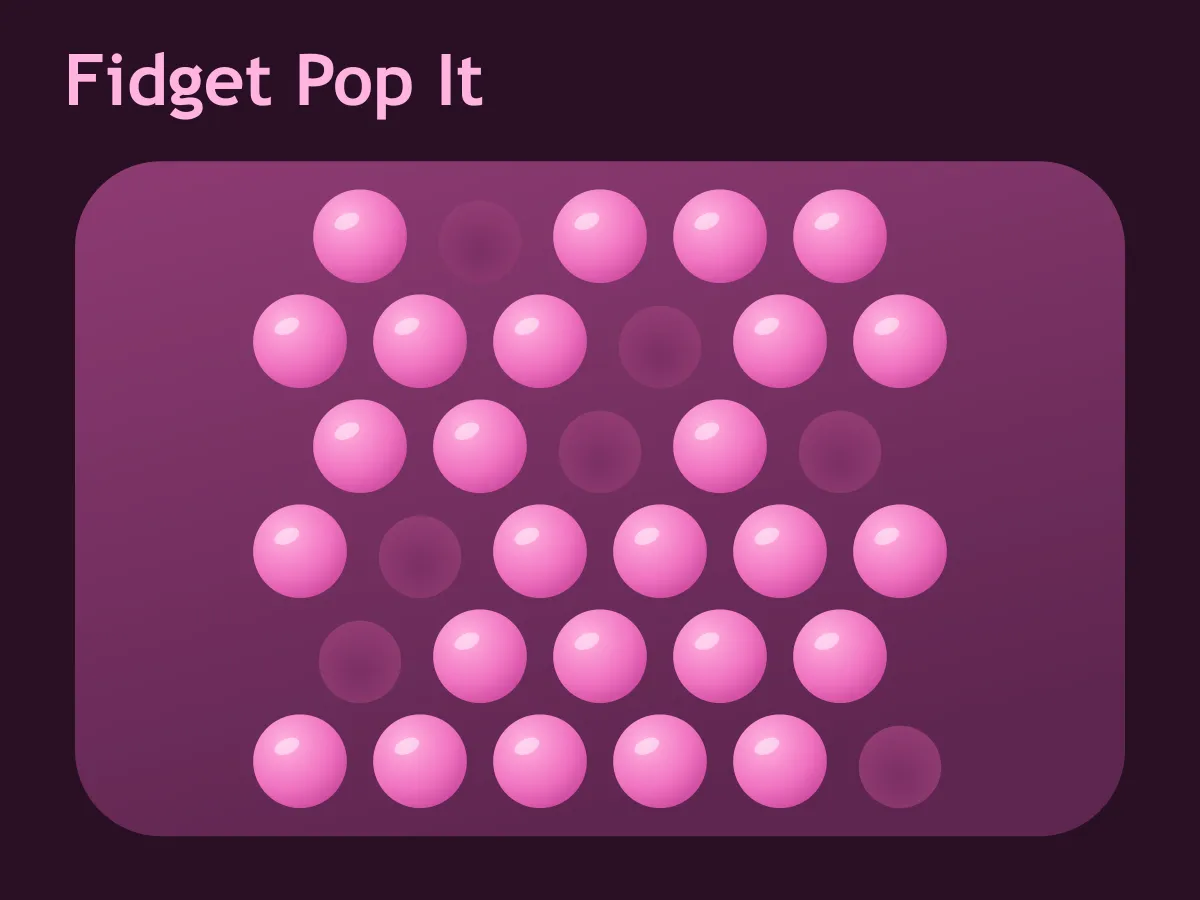
Fidget Pop It is a free online version of the silicone bubble sheet, with the object modelled properly rather than as a grid of checkboxes. A bubble that is up goes down when you press it and stays down — the only way to press it again is to turn the whole sheet over, which brings every bubble back at once, exactly like the toy. There is nothing to fail at and nothing is ever lost, which is the entire appeal, and the counters just tell you how many you have popped and how long your current run is. Laid on top is the game people actually play with one: two players take turns popping as many bubbles as they like from a single row, and whoever is left facing the last bubble loses. That is misère Nim, which has a known perfect strategy — so the computer here can play it perfectly, and the difficulty is how often it chooses to. Three settings, all read off a measured table rather than guessed: against a player who is not counting they win about a third, a fifth and a tenth of the games; against a player who is counting they win none at all, because the six rows on the sheet are a first-player win and Nim does not care how hard you try after that. The perfect-play rule was written backwards from memory the first time, which made the sheet resign from winning positions, so it is checked against a brute-force solver in the test suite rather than against recollection.
How to play Fidget Pop It
- Press Play. The sheet starts with every bubble up.
- Click or tap a bubble to pop it. It stays down, the way the toy does.
- When you have had enough, press Turn it over and every bubble comes back.
- The counters track how many you have popped in total and how long your current unbroken run is.
- For the game, press Play last bubble. You and the sheet take turns.
- On your turn, pop as many bubbles as you like — but all from the same row. The first one you press picks the row.
- Press End turn to hand over. You have to take at least one bubble.
- Whoever is left taking the very last bubble on the sheet loses, so the aim is to leave it to the other side.
- The sheet plays as well as its setting says: Easy, Fair or Sharp. You can change it between games.
- With one row left holding more than one bubble, leave an odd number of single-bubble rows for the sheet. That is the whole trick.
Tips
- In the toy, there is nothing to get right. The counters are there if you want them and ignoring them costs nothing.
- In the game, count rows of one. With every row down to a single bubble, you want to hand over an odd number of them.
- While two or more rows still hold several bubbles, the rule is different: match the rows up so their sizes cancel — 3 and 3, or 5 and 4 and 1.
- Taking a whole row is often the right move, not a wasteful one. Size is what matters, not how many turns it takes.
- You move first, and on a full sheet that is a winning position. If you have lost, you gave it away somewhere.
- Against Sharp, a single loose move loses the game and there is no recovering it — that is Nim, not the setting being unfair.
- Against Easy the sheet plays like a person: it takes a handful out of a row it liked the look of, which is often exactly the wrong move.
- If you are learning, play Easy and watch what the sheet leaves behind when it wins. That position is the one to aim for.
FAQ
Is Fidget Pop It free to play?
Yes. It runs free in your browser with no download, no install and no account.
Why can I not press a bubble twice?
Because the sheet has two sides. A popped bubble is down until you turn the whole sheet over, which brings them all back at once — pressing one twice would make it a grid of checkboxes rather than an object.
Is there any way to lose in the toy?
No. Nothing is timed, nothing is scored against you and nothing is lost. The counters are there if you want them.
What is the last-bubble game?
Two players take turns popping as many bubbles as they like from one row, and whoever takes the very last bubble on the sheet loses. It is the game people play with the real toy.
Is there a strategy, or is it luck?
It is pure strategy — the game is misère Nim, which is solved. While more than one row holds several bubbles, leave the row sizes cancelling each other out; once only one row is big, leave an odd number of single-bubble rows.
Can I beat the Sharp setting?
Yes, and reliably: you move first and a full sheet is a first-player win. Sharp simply punishes every mistake, so a game you lose there is one you gave away.
How were the difficulty settings chosen?
By measurement. Each setting is the chance the sheet finds the winning move, and over three hundred games a setting they are worth about a third, a fifth and a tenth of the games to a player who is not counting.
Does the sheet ever play badly on purpose?
Yes, that is what the settings are. When it is not playing the winning move it takes a few bubbles from a row it picked, which is what someone playing without counting does.